Choosing a Viking river cruise in Europe sounds simple at first. You choose a river, pick a date, select a cabin and start looking forward to the trip. But once you begin comparing all the options, the decision can quickly become overwhelming. This Viking Europe river cruise guide is designed to help you narrow the choice before you spend hours opening different cruise pages and trying to compare everything yourself.
After our first Viking river cruise, we thought choosing the next one would be easy. Our first Viking cruise was a Christmas market cruise on the Rhine, and it was a fabulous experience. Coming from the warm climate of Thailand, we wanted something cooler, more festive and completely different. The Rhine Christmas markets delivered exactly that.
So when we started looking for our next Viking river cruise, we assumed the hardest decision had already been made. We knew we liked Viking. We knew we enjoyed river cruising. And we knew we wanted to return to Europe.
Then we opened the Viking website.
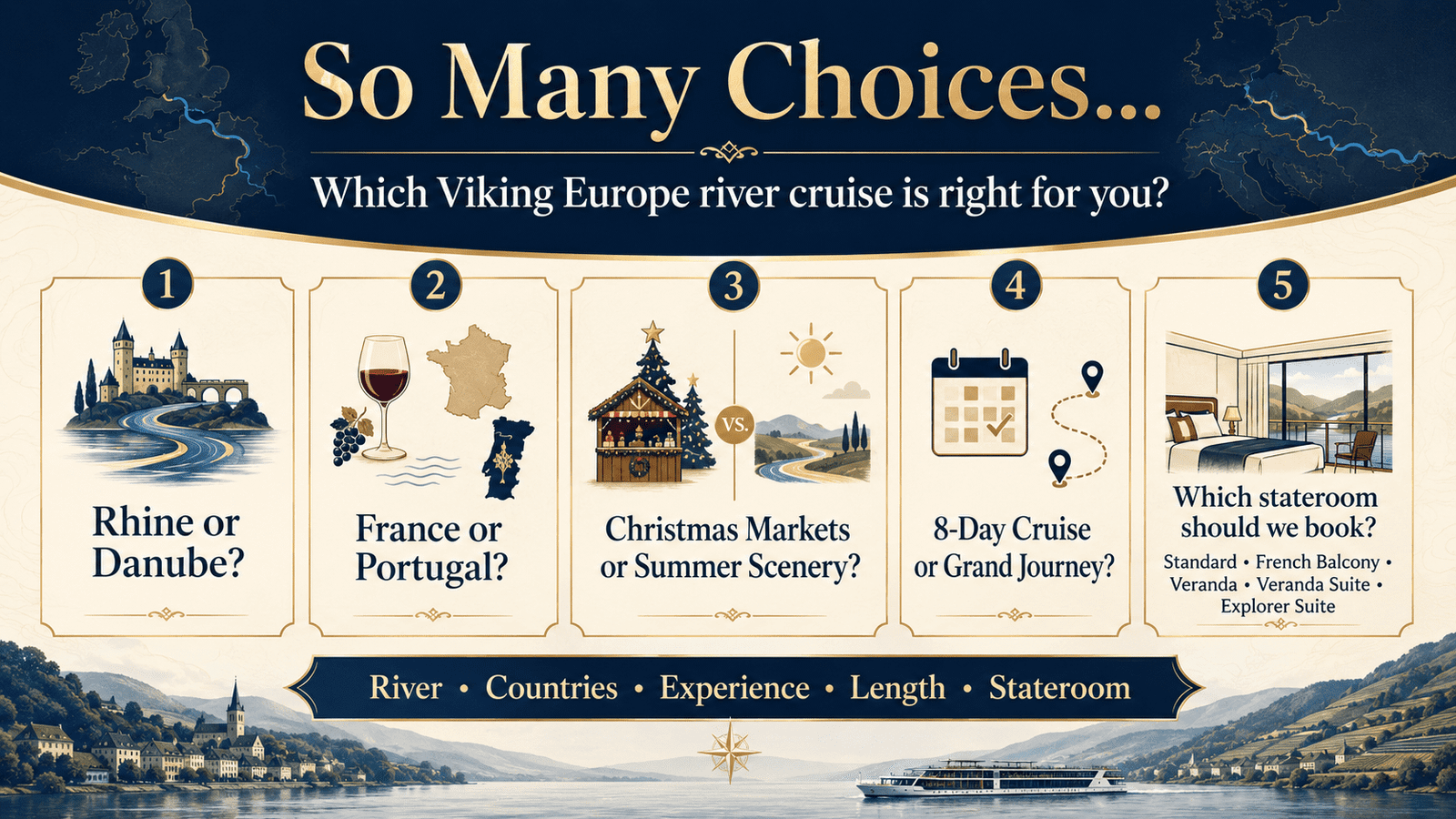
Suddenly, the choice was not simple at all. Should we choose the Rhine or the Danube? France or Portugal? Christmas markets or summer scenery? An eight-day cruise or a longer grand journey? A Standard Stateroom, French Balcony, Veranda Stateroom, Veranda Suite or Explorer Suite?
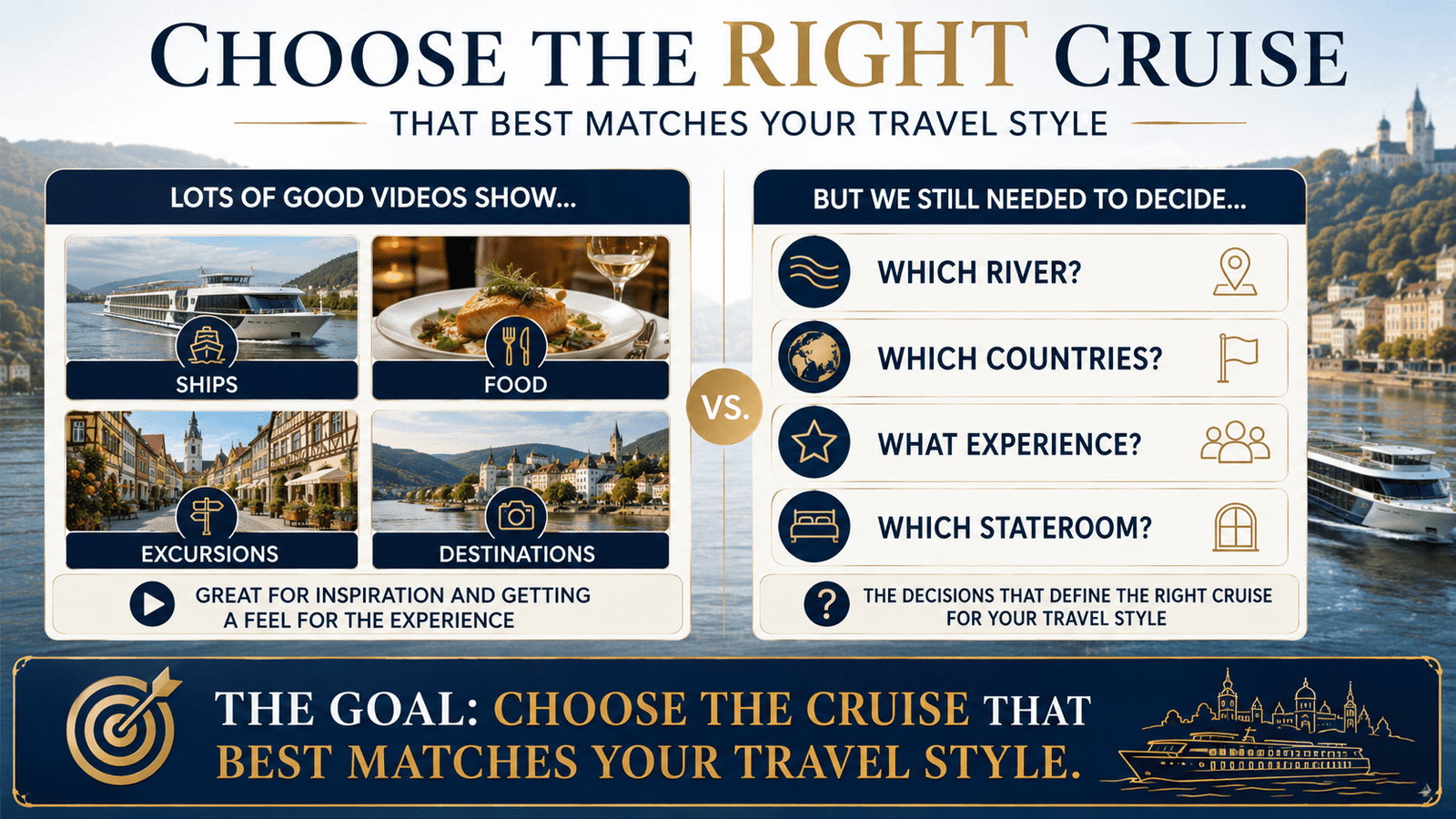
Viking has built a strong reputation for consistent European river cruising, so it is likely that many travellers will enjoy whichever itinerary they choose. But when you are spending this amount of money, “probably good” is not enough. You want the cruise that best matches your travel style, budget, mobility, interests and expectations.
Viking Europe River Cruise Guide: Start With the Finder
To make the decision easier, we created a free spreadsheet and interactive cruise finder to help compare Viking Europe river cruises side by side.
👉 Open our Viking Europe River Cruise Comparison Spreadsheet
The spreadsheet includes river and region comparisons, itinerary notes, ship styles, cabin categories, estimated costs and booking considerations.
The most useful part is the Interactive Viking Cruise Finder, which helps you narrow the options based on the river or region, travel style, stateroom type, trip length, season and activity level you are considering.
👉 Use the Interactive Viking Cruise Finder here
It is not designed to replace Viking’s website. You should always confirm current prices, dates, availability, inclusions and stateroom details directly before booking. But it is designed to help you make sense of the choices before you start comparing individual sailings.

Why Choosing the Right Viking River Matters
One of the biggest mistakes people make when choosing a European river cruise is assuming that all rivers offer a similar experience.
They do not.
The ship may feel familiar from one Viking itinerary to another, especially on the Longships, but the river itself changes the journey. The Rhine, Danube, Seine, Douro, Moselle, Main, Elbe and French waterways all have different scenery, towns, history, food, walking conditions and seasonal appeal.
That is why choosing the right river usually matters more than simply choosing the first itinerary that appears on sale.
The Rhine may be perfect if you imagine castles, vineyards and classic river scenery. The Danube may suit you better if you want grand cities, music, architecture and Central European history. The Seine may appeal if you are interested in Paris, Normandy, art, French villages and D-Day history. The Douro may be ideal if you want terraced vineyards, warmer weather and Portugal’s wine country.
If you are still comparing European river cruising more generally, our European river cruise comparison guide is a useful starting point before narrowing the choice to Viking.
Rhine River Cruises: Castles, Vineyards and Classic Scenery
The Rhine is one of the easiest Viking Europe choices to understand.
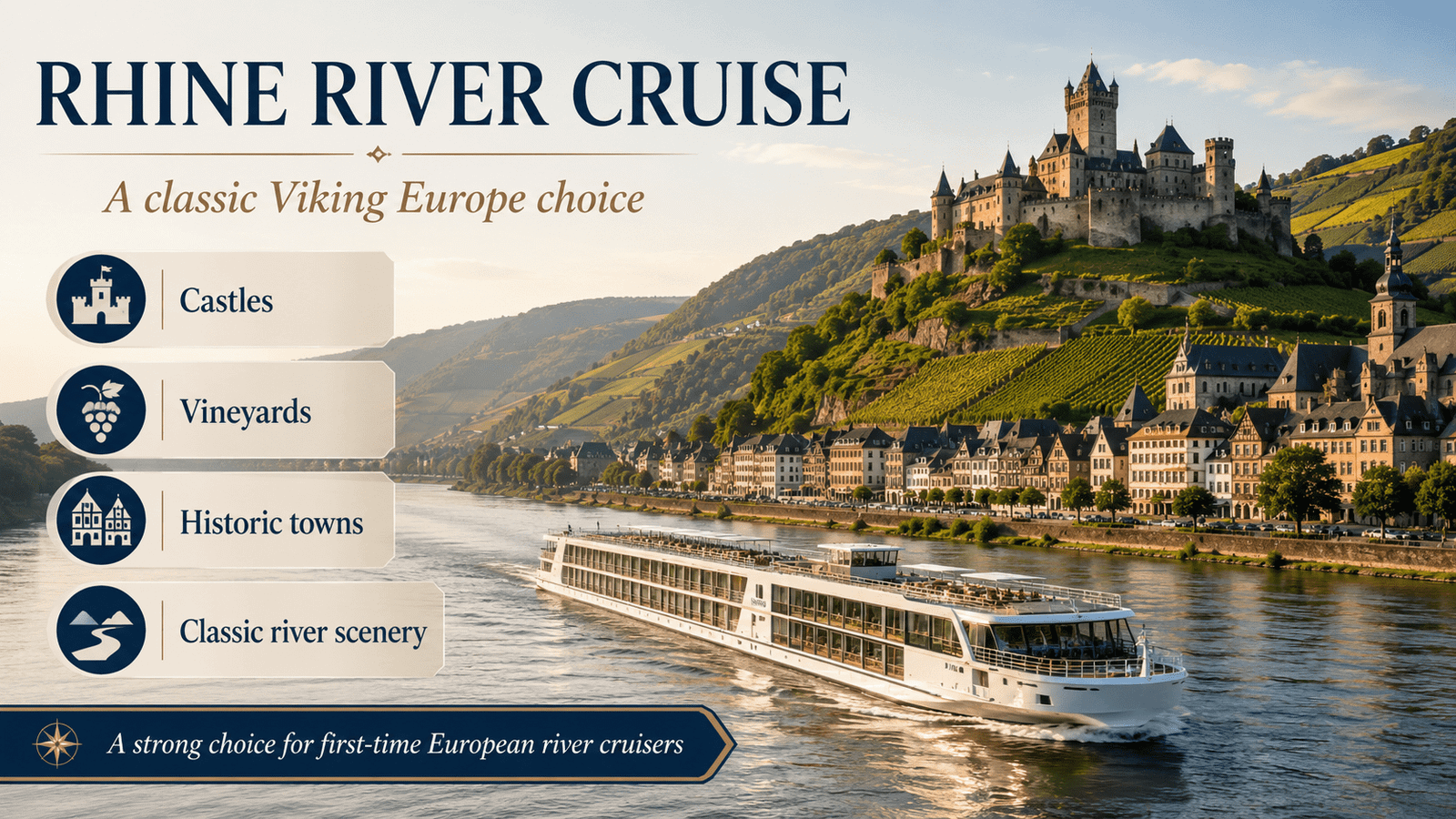
If your idea of a European river cruise includes castles, vineyards, historic towns, scenic bends in the river and picture-postcard villages, the Rhine is a very strong option.
For many first-time river cruisers, the Rhine feels like the classic European river cruise experience. It offers a good balance of scenery, culture and history without feeling too difficult to understand. Depending on the itinerary, you may visit parts of Germany, the Netherlands, France or Switzerland, and some cruises connect naturally with cities such as Amsterdam or Basel.
The Rhine is also popular for Christmas market cruises. This is why it appealed to us for our first Viking river cruise. The festive atmosphere, cooler weather and historic towns made it feel very different from our normal life in Thailand.
The Rhine may suit first-time Viking river cruisers, couples, seniors and travellers who want a scenic, comfortable and easy-to-understand introduction to river cruising.
Danube River Cruises: Grand Cities and Central European Culture
The Danube offers a different experience from the Rhine.
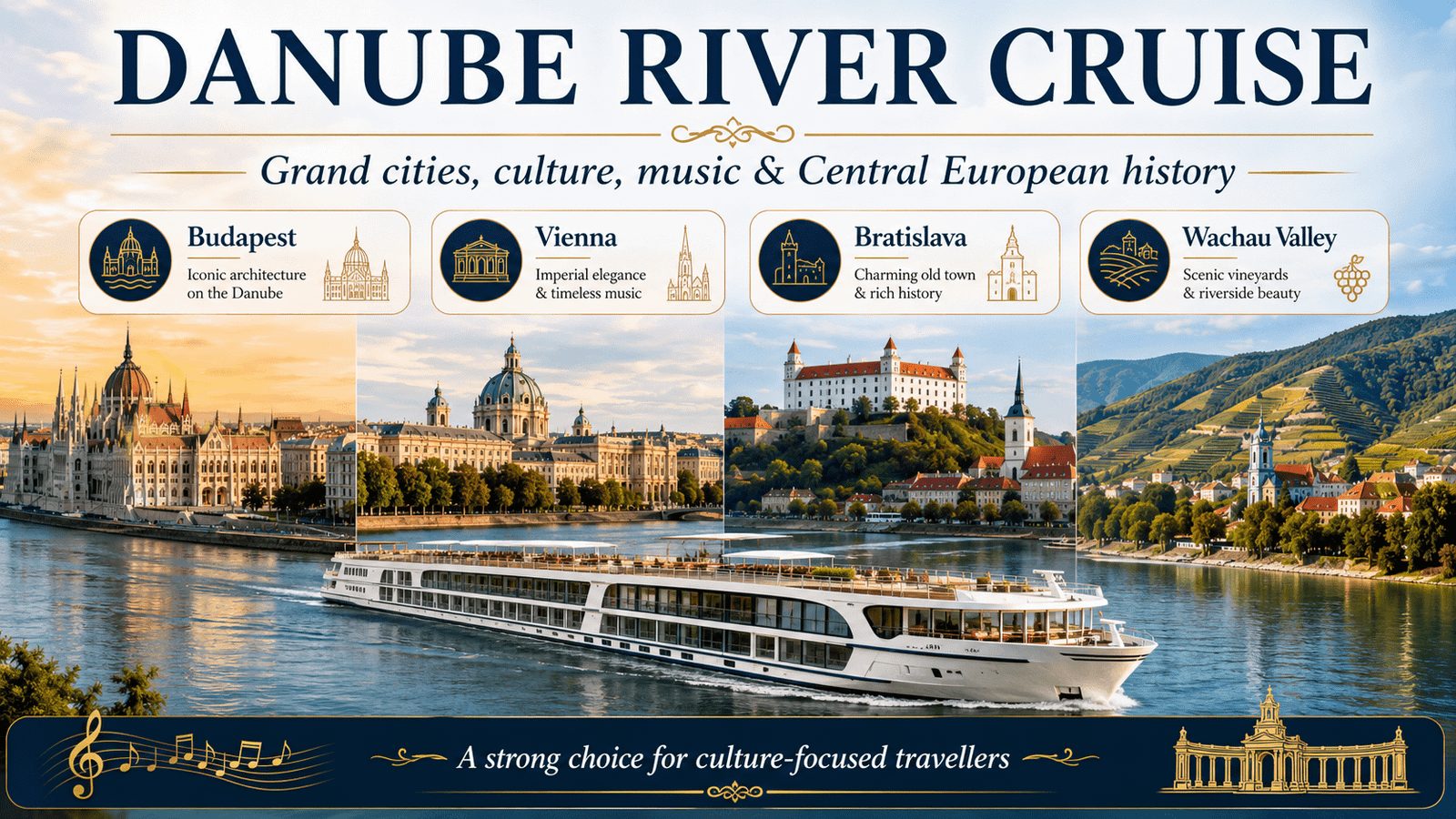
Where the Rhine often feels more focused on castles, vineyards and river scenery, the Danube is often about grand cities, classical music, architecture and Central European history.
Depending on the itinerary, you may visit places such as Budapest, Vienna, Bratislava, Passau or other historic cities along the route. The Danube can feel more cultural and city-focused than some Rhine itineraries, especially if your cruise includes major capitals.
This can make the Danube a good choice for travellers who enjoy music, museums, architecture, history and elegant European cities.
If you are deciding between the Rhine and Danube, think carefully about whether your dream cruise is built more around scenery and castles or cities and culture. Our broader European river cruise comparison may help if you are still comparing rivers, regions and cruise styles.
France River Cruises: Seine, Bordeaux, Rhône and Saône
Viking’s French river cruises offer a very different style of experience from the Rhine and Danube.
The Seine is often associated with Paris, Normandy, art, French villages and D-Day history. For travellers interested in World War history, Impressionist art or the atmosphere of northern France, the Seine can be a very meaningful choice.
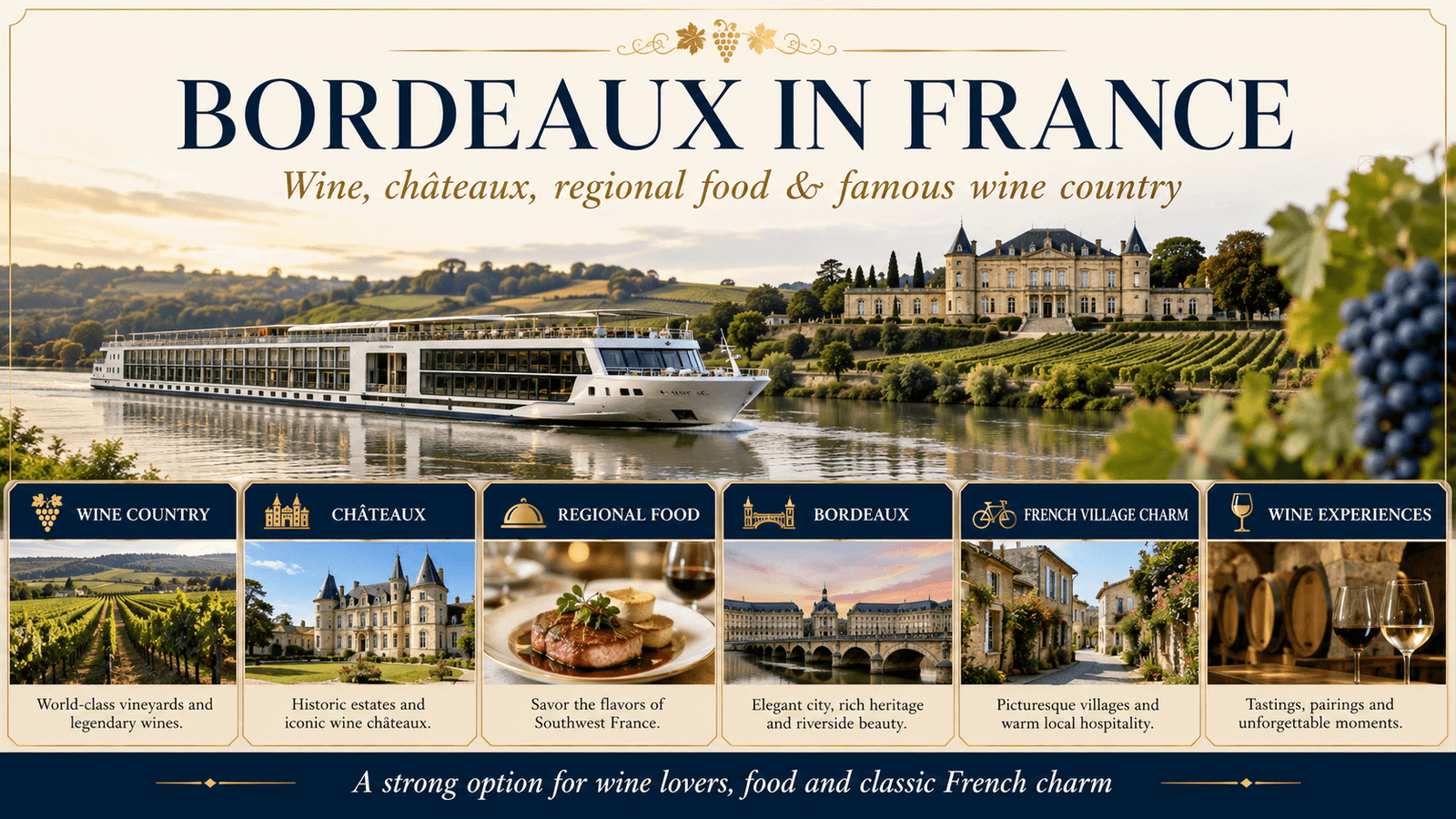
Bordeaux is different again. This region is more focused on wine, regional food and some of Europe’s most famous wine country. If your ideal river cruise includes vineyards, tastings, French cuisine and a slower regional experience, Bordeaux may be more appealing than the Rhine or Danube.
Southern France itineraries on the Rhône and Saône can offer another variation, often combining Roman history, food, wine, Provence and Burgundy.
France is not one single river cruise experience. Paris and Normandy, Bordeaux, Burgundy and Provence all offer different reasons to travel.
Douro River Cruises: Portugal, Wine and Warm Scenery
The Douro River in Portugal is one of the most visually distinctive Viking river cruise options in Europe.
The river is known for terraced vineyards, warm weather, beautiful scenery and strong wine culture, especially around the port wine region. Most Douro cruises operate from Porto and travel inland through the Douro Valley toward the Spanish border.
Compared with the Rhine or Danube, the Douro can feel warmer, slower-paced and more regional. It is less about moving between famous European capitals and more about wine country, landscapes, small towns and local culture.
The Douro may suit travellers who have already done one of the classic European rivers and want something a little different. It may also appeal to couples looking for a scenic and relaxed itinerary.
However, the Douro can involve hills, steps and excursions through vineyard areas, so travellers with walking difficulties should check excursion details carefully. If mobility is a concern, our guide to the best river cruises for seniors with walking difficulties may help you think through the practical side before booking.

Moselle, Main and Elbe: Quieter or More Niche Viking Choices
Beyond the major rivers, Viking also offers itineraries that include the Moselle, Main and Elbe.
The Moselle is often considered a quieter and very scenic alternative to the Rhine. It is known for steep vineyard landscapes, small wine towns and a slower, more intimate atmosphere. If you like wine regions and pretty river scenery but want something less obvious than the Rhine, the Moselle may be worth considering.
The Main River is often part of longer journeys connecting the Rhine and Danube through the Main-Danube Canal. It may not be as famous as the Rhine or Danube, but it adds variety to longer itineraries, with places such as Würzburg, Bamberg and smaller medieval towns along the way.
The Elbe is one of Viking’s more niche European river options. It flows through parts of Germany and the Czech Republic and is often associated with Berlin, Dresden, Wittenberg and Prague, although Prague is usually reached by land transfer rather than directly by ship.
The Elbe may suit travellers who want history, quieter scenery and a less crowded feel compared with the Rhine or Danube. However, river conditions and ship types can be more specialised, so it is important to check the details of the specific itinerary.

Viking Longships and Specialised European River Ships
One reason many travellers like Viking is consistency.
Viking’s European Longships are designed to feel familiar from one ship to another. They generally carry around 190 guests and offer a calm Scandinavian-inspired style, with efficient cabins, a main restaurant, the Aquavit Terrace, a lounge and a sun deck.
This consistency can be reassuring, especially for first-time river cruisers. Once you understand the Longship layout, you have a good idea of what many Viking European river ships will feel like.
However, not every Viking European river ship is exactly the same.
Some rivers require smaller or more specialised vessels because of river conditions, bridge heights, locks or waterway restrictions. The Douro and Elbe are good examples of rivers where ship design can differ from the standard Longship experience.
This matters because ship differences may affect passenger numbers, cabin categories, amenities and public spaces. Before booking, always check the actual ship used on your itinerary rather than assuming every Viking river ship is identical.
If you are comparing river cruising with ocean cruising later in life, you may also find our article on Viking Ocean vs Viking River after 70 useful, because the onboard experience is very different.
 Viking
Stateroom Categories Explained
Once you have chosen the river, the next big decision is the stateroom.
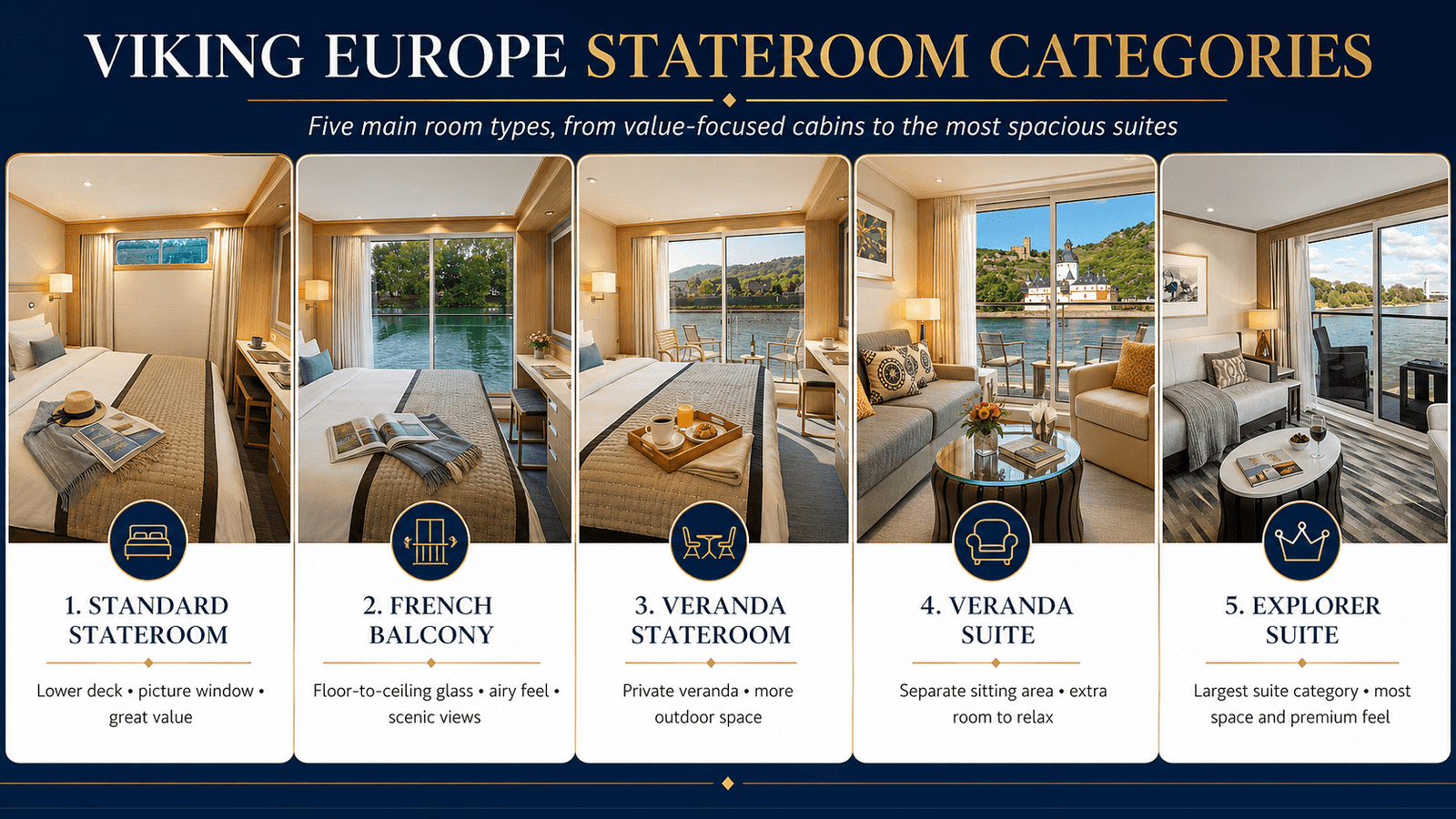
Viking’s European river ships usually offer five main stateroom types: Standard Stateroom, French Balcony, Veranda Stateroom, Veranda Suite and Explorer Suite. The exact categories can vary by ship, especially on smaller or specialised vessels, so always check the deck plan for your sailing.
The Standard Stateroom is usually the entry-level option. It sits lower on the ship and has a picture window rather than a balcony. This may be fine if you are trying to keep costs down, but it is not ideal if you want to enjoy a lot of passing scenery from your room.
On an ocean cruise, a cheaper cabin can make sense because there may not be much to see between ports. On a river cruise, however, the scenery is a major part of the experience. Villages, castles, vineyards, bridges and riverbanks can pass by throughout the day.
A French Balcony gives you full-height opening doors and fresh air, but not a step-out balcony. For many travellers, this is a good middle ground. You feel more connected to the river without paying for a larger cabin.
A Veranda Stateroom gives you a proper step-out balcony, while a Veranda Suite gives you more space as well as balcony access. Explorer Suites are usually the top category on many Viking Longships, offering the most space and premium positioning.
The best stateroom depends on your budget and how much time you expect to spend in the cabin. If you enjoy quiet time watching the river, it may be worth paying more for at least a French Balcony.
For couples comparing cabin comfort, itinerary style and onboard atmosphere, our guide to the best river cruises for couples may give you more ideas before choosing a category.
Viking River Cruise Costs: Why Comparing Prices Is Difficult
This is where choosing a Viking river cruise can become frustrating.
Viking’s website is useful, but there is no simple way to compare every cruise, date and stateroom category side by side unless you open multiple pages or build your own comparison system.
For example, if you want to know whether a Christmas market cruise is cheaper in early December or late December, you may need to open different sailings and compare manually. If you want to compare a French Balcony with a Veranda Stateroom across several itineraries, that can also take time.
And if you are comparing the Rhine, Danube, France, Douro and Elbe, the process can become even more confusing.
The headline price is only part of the decision. You also need to think about cruise length, cabin category, included flights or promotions, transfers, extensions, season and whether you are travelling at a peak time.
A Viking cruise that looks cheaper at first may not be the best choice if it is not the river, season or stateroom experience you really want. A more expensive itinerary may actually be better value if it suits your travel style more closely.
When comparing prices, you can also check current Viking river cruise offers through CruiseDirect or compare reviews and ship information through Cruise Critic. I would still use Viking’s own website to confirm the exact itinerary, ship, stateroom category and inclusions before booking.
This is why the Interactive Viking Cruise Finder can be useful. It gives you a simpler starting point before you go back to Viking’s website or your preferred booking provider to confirm live pricing.

How to Use the Interactive Viking Cruise Finder
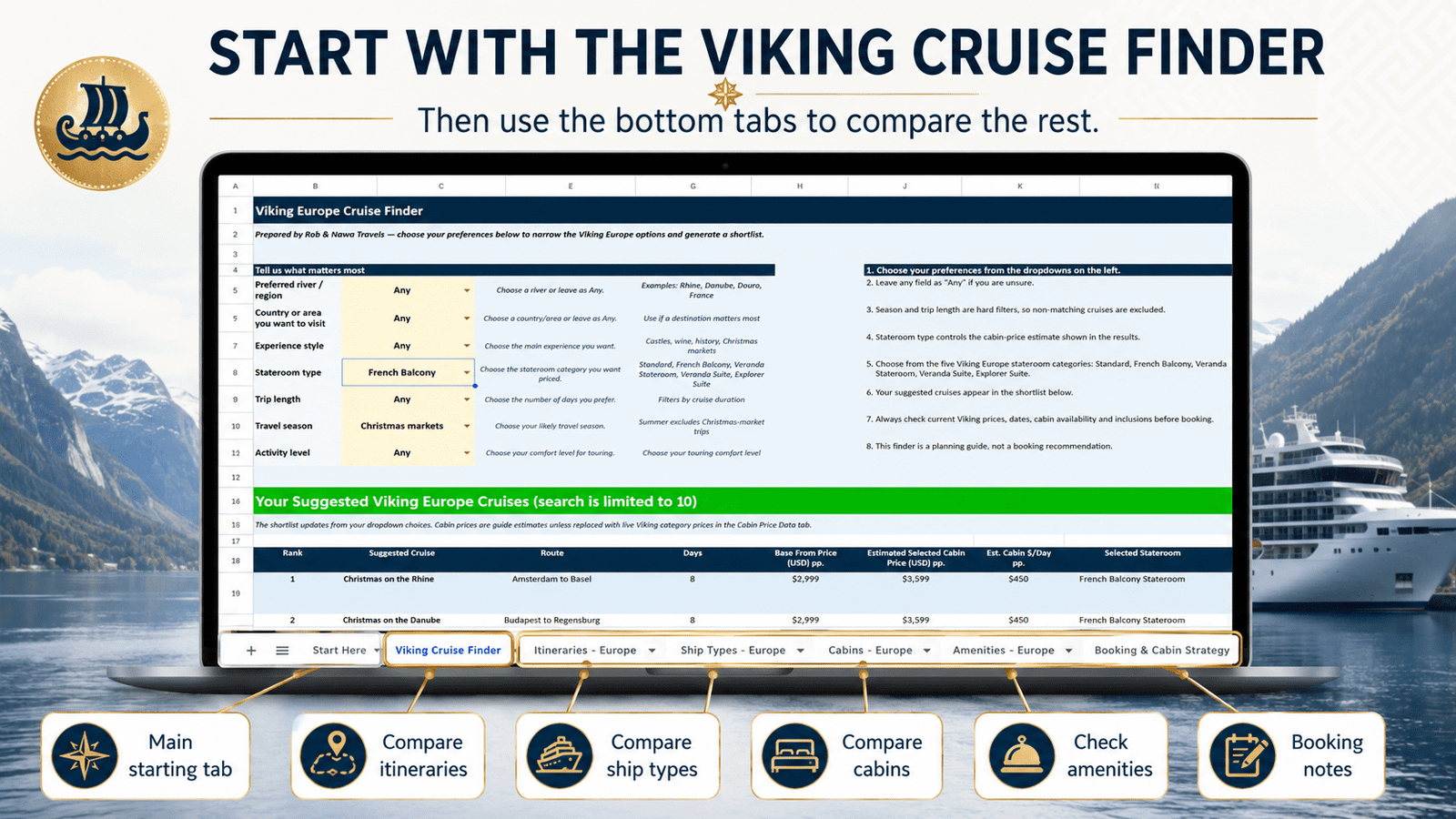
The interactive cruise finder is designed to help you narrow down Viking Europe river cruises by river, region, experience, stateroom, season, trip length, activity level and estimated cost.
For example, you might choose a wine-focused cruise in France or Portugal, a history-focused Seine itinerary, a castle-focused Rhine cruise, or a Christmas market cruise through Germany and Austria.
You can also compare the stateroom type you are considering, the length of the trip and the season you prefer.
Activity level is another important part of the finder. A tulips and windmills cruise through the Netherlands may feel easier and flatter than a more hilly itinerary through parts of the Douro or Rhine regions. That matters if you are concerned about walking distances, cobblestones, stairs or uneven ground.
👉 Open the Interactive Viking Cruise Finder
Use it as a planning tool, not as the final booking source. Once you have narrowed down your preferred river, season and cabin type, check current prices through CruiseDirect, compare traveller reviews on Cruise Critic, and then confirm the exact dates, availability, inclusions and stateroom details directly with Viking or your travel advisor before booking.
If you are still deciding whether river cruising is the right style of trip, our guide to the best river cruises for seniors may help you compare the wider options.
What Viking River Ships Do Not Offer
One thing that surprises some travellers is how destination-focused Viking’s European river ships are.
If you are used to ocean cruising, you should not expect big-ship facilities such as large gyms, spas, pools, multiple restaurants, casinos or large entertainment venues.
Most Viking European river ships do not have a gym, spa or pool. The Douro ships are an exception, with a small pool on the sun deck.
This does not make the ships worse. It simply means river cruising is a very different experience from ocean cruising. The focus is the river, the towns, the included excursions and the ease of travelling from place to place without repacking every night.
If you want a cruise that feels like a floating resort, Viking river cruising may feel too quiet. But if you want a calm ship, easy logistics, included touring and close access to historic towns, that quieter river cruise style may be exactly what you want.

Final Thoughts: Which Viking Europe River Cruise Should You Choose?
There is no single best Viking Europe river cruise for everyone.
The Rhine may be the best choice if you want castles, vineyards, scenic cruising and a classic first river cruise. The Danube may suit you better if you want grand cities, culture, music and Central European history. The Seine is strong for Paris, Normandy, art and D-Day history. Bordeaux, Rhône and Saône itineraries are excellent for travellers who love French food, wine and regional culture. The Douro is warm, scenic and wine-focused. The Moselle is quieter and beautiful. The Elbe is more niche and history-rich.
The right choice depends on what you want from the journey.
Do you want scenery, cities, wine, history, Christmas markets, warm weather, easier walking, a longer grand journey or a slower regional itinerary?
Once you answer that, the Viking website becomes much easier to navigate.
And if you are still unsure, use the spreadsheet approach. Start with the river, then the season, then the itinerary length, then the stateroom category and finally the price.
👉 Use our Viking Europe River Cruise Comparison Spreadsheet and Cruise Finder here
That way, you are not just choosing the cruise that looks attractive on the website. You are choosing the Viking Europe river cruise that best fits the way you actually like to travel.