Choosing an Asian river cruise is very different from choosing a European river cruise. A proper Asian river cruise comparison is not just about asking which ship is better or which cruise line has the best price. It starts with a much bigger question: which river actually suits the journey you want to have?
That is because the Mekong, Yangtze, Ganges, Brahmaputra and Red River all offer very different travel experiences. Some focus on village life, floating markets, Buddhist temples and local traditions. Others are about dramatic scenery, ancient cities, spiritual ceremonies, wildlife, tea country or more expedition-style travel.
So before you choose the cruise line, you need to choose the river.
That one decision can change almost everything: the scenery, the culture, the ship size, the activity level, the season, the comfort level and even the type of traveller the cruise may suit best.
For senior travellers especially, this matters. The right Asian river cruise can be fascinating, comfortable and deeply memorable. The wrong one may feel too intense, too remote, too hot, too busy or simply not what you expected.
If you are still comparing different cruise styles across Asia, you may also find our broader guide to the best Asian cruises for seniors useful.
Start Here: Our Asian River Cruise Comparison Spreadsheet
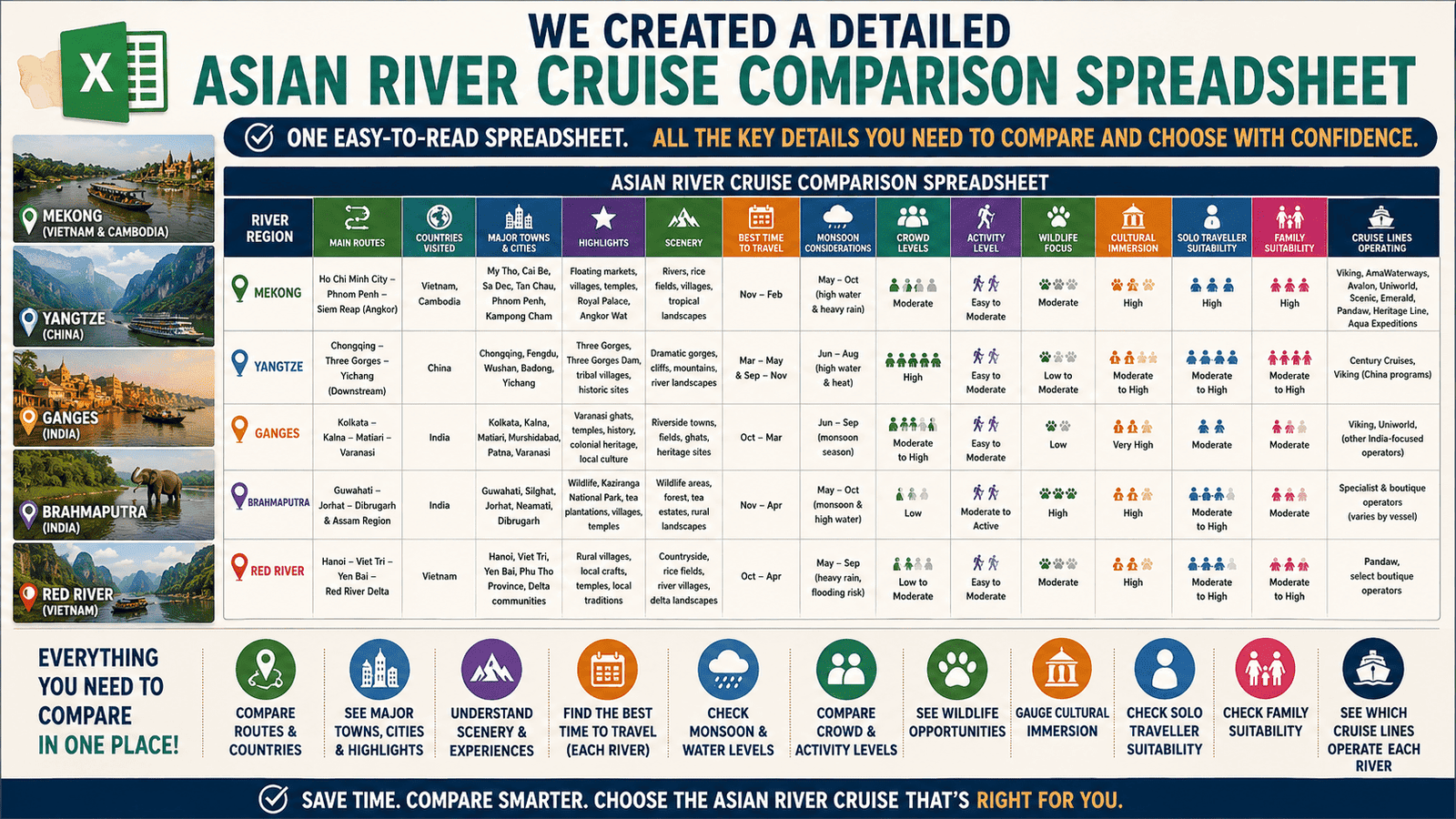
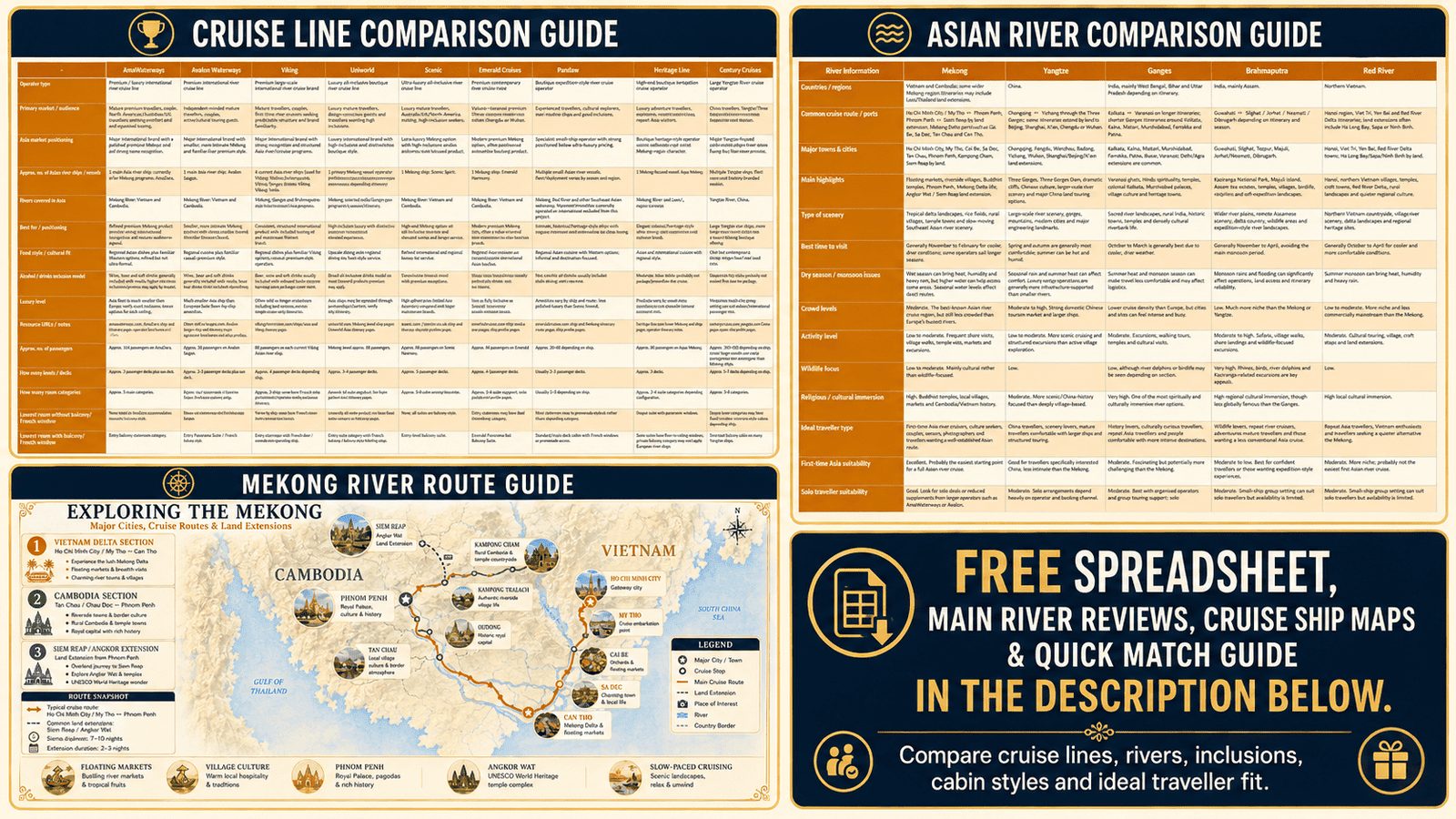
Before we go river by river, we have created a detailed Asian River Cruise Comparison Spreadsheet to help you compare the main options side by side.
👉 View our free Asian River Cruise Comparison Spreadsheet here
This spreadsheet compares the main Asian river cruise regions, including the Mekong, Yangtze, Ganges, Brahmaputra and Red River. It includes cruise routes, countries visited, major towns and cities, scenery, highlights, best time to travel, monsoon considerations, crowd levels, activity level, wildlife focus, cultural immersion, solo traveller suitability, family suitability and cruise lines operating on each river.
We have also included a cruise line comparison section covering ship sizes, passenger numbers, cabin styles, dining, drinks, excursions, inclusions and traveller suitability.
The article below gives you the story and context. The spreadsheet gives you the side-by-side details.
Why Asian River Cruises Are So Different From European River Cruises
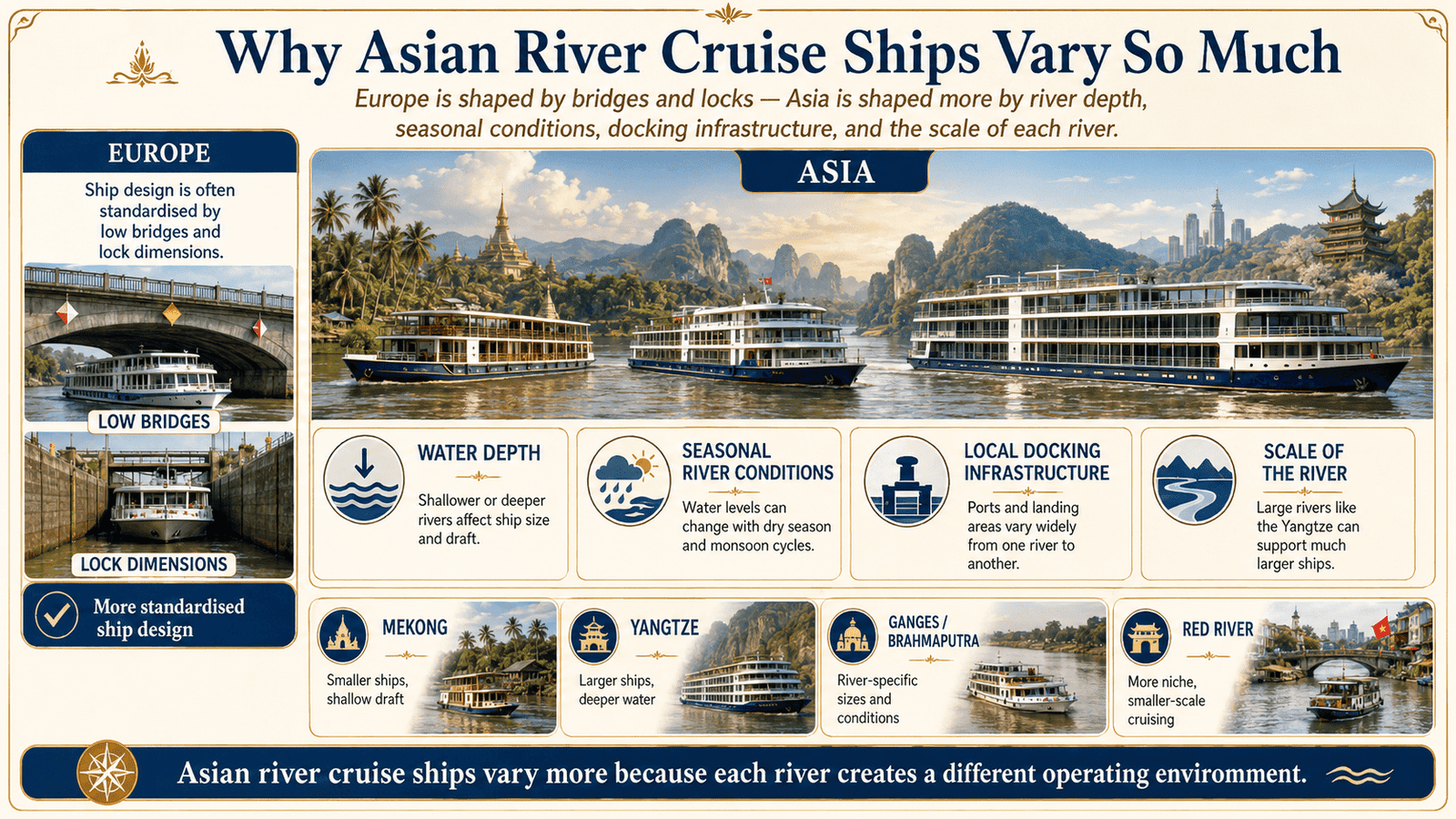
European river cruising often has a familiar rhythm. Many ships sail through historic towns, vineyard valleys and city centres. The vessels can look quite similar because they are shaped by low bridges, narrow locks and strict river dimensions.
Asia is different.
On the Mekong, ships are often smaller and more shallow-drafted because of seasonal water levels, smaller landing areas and less developed docking infrastructure. On the Yangtze in China, the river is much larger and deeper, with more established cruise infrastructure. Ships there can be much bigger, sometimes feeling closer to small ocean-style vessels than boutique European river ships.
In India, the Ganges and Brahmaputra offer yet another style of travel. These cruises are less about polished sightseeing and more about spirituality, culture, wildlife, villages and deep local experiences.
That is why comparing Asian river cruises only by price can be misleading. A cheaper cruise on one river may offer a completely different type of journey from a more expensive cruise somewhere else.
You need to compare the river, the country, the season, the ship, the comfort level and the kind of experience you really want.
Mekong River Cruises: The Classic First Asian River Cruise
If you are planning your first Asian river cruise, the Mekong is often one of the strongest places to begin.
The Mekong River begins high in the Tibetan Plateau and eventually flows through several countries, including China, Myanmar, Laos, Thailand, Cambodia and Vietnam, before reaching the Mekong Delta and flowing toward the South China Sea.
Most mainstream Mekong river cruises focus on the lower section of the river, travelling through Vietnam and Cambodia. These cruises often operate between the Mekong Delta near Ho Chi Minh City and central Cambodia, sometimes connecting with land touring to places such as Phnom Penh, Siem Reap and Angkor Wat.
The Mekong is the river many travellers imagine when they think of Southeast Asia. You may visit riverside villages, floating markets, Buddhist temples, local workshops and traditional communities. It is often a journey built around people and everyday life as much as scenery.
The Mekong may also appeal to Vietnam veterans, their families and travellers interested in more recent history. While most Mekong cruises are not specifically war-history cruises, the Mekong Delta was an important region during the Vietnam War. Many cruises begin or end near Ho Chi Minh City, where travellers can add visits to places such as the Cu Chi Tunnels, the War Remnants Museum and the Reunification Palace.
For many senior travellers, the Mekong offers a good balance. It feels adventurous without being too remote. It gives you culture, local life, history and scenery, but with enough cruise infrastructure to make the journey manageable.
The best time to visit is generally during the drier, cooler months, especially from around November to February, when temperatures are usually more comfortable and rainfall is lower.
The Mekong also has the widest choice of international and boutique cruise operators in Asia. Depending on the itinerary and season, you may find companies such as Viking, AmaWaterways, Avalon Waterways, Uniworld, Scenic, Emerald, Pandaw, Heritage Line and Aqua Expeditions operating in the region.
For many travellers, the Mekong is the easiest first step into Asian river cruising. If this river is high on your list, our guide to Mekong River cruises for seniors goes into more detail.

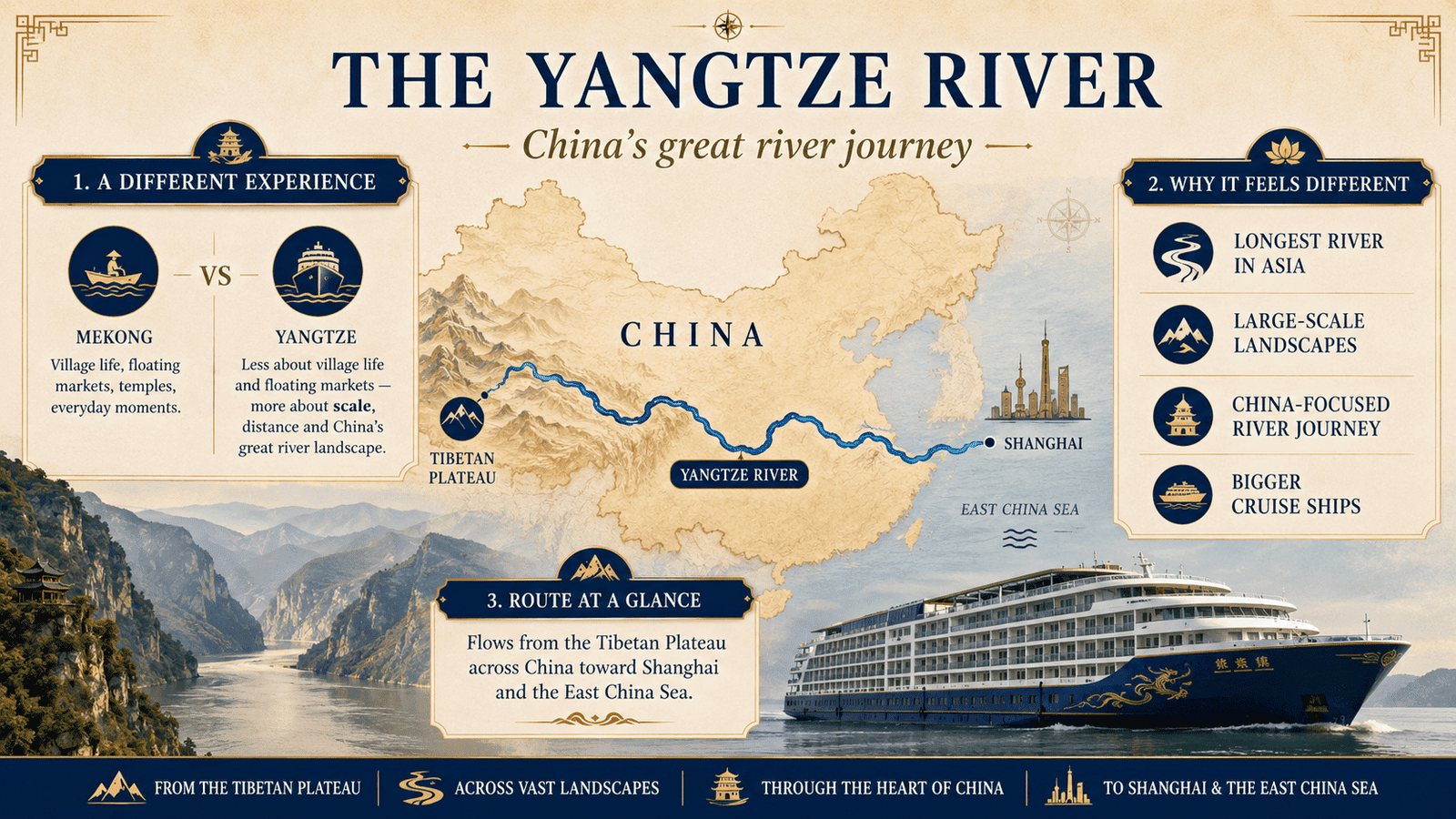
Yangtze River Cruises: China on a Much Larger Scale
The Yangtze offers a very different experience from the Mekong.
Where the Mekong often feels intimate, local and village-focused, the Yangtze is about scale. This is China’s great river journey.
The Yangtze is the longest river in Asia, flowing from the Tibetan Plateau across China toward Shanghai and the East China Sea. Most mainstream Yangtze river cruises focus on the famous Three Gorges section, usually sailing between Chongqing and Yichang.
A downstream cruise from Chongqing to Yichang commonly takes around four days and three nights, while an upstream cruise from Yichang to Chongqing may take around five days and four nights. Some longer itineraries combine the cruise with broader China land tours, including Beijing, Shanghai, Xi’an or Chengdu.
The main highlights are the Three Gorges: Qutang Gorge, Wu Gorge and Xiling Gorge. Many cruises also include the Three Gorges Dam, one of the largest engineering projects in the world, along with shore excursions to tributaries, cultural sites, historic towns and scenic areas.
The ships on the Yangtze can be much larger than those found on rivers such as the Mekong, Ganges or Brahmaputra. For some travellers, this is a positive. Larger ships may offer more public space, more facilities and a more familiar cruise structure.
For others, the experience may feel less intimate than the boutique-style river cruising they expected.
The best times to travel are generally spring and autumn, when temperatures are usually more comfortable. Cruises may operate across much of the year, but weather, haze, crowds and river conditions can vary.
The Yangtze may suit travellers who want to combine a river cruise with a wider China itinerary. It is less about small village immersion and more about dramatic scenery, major engineering, Chinese history and the scale of modern China.
If you enjoy cruising in Asia but are still deciding between river and ocean options, our guide to the best ocean cruises in Asia for seniors may also help.
Ganges River Cruises: Spiritual, Cultural and Deeply Immersive
The Ganges offers one of the most culturally and spiritually distinctive river cruise experiences in Asia.
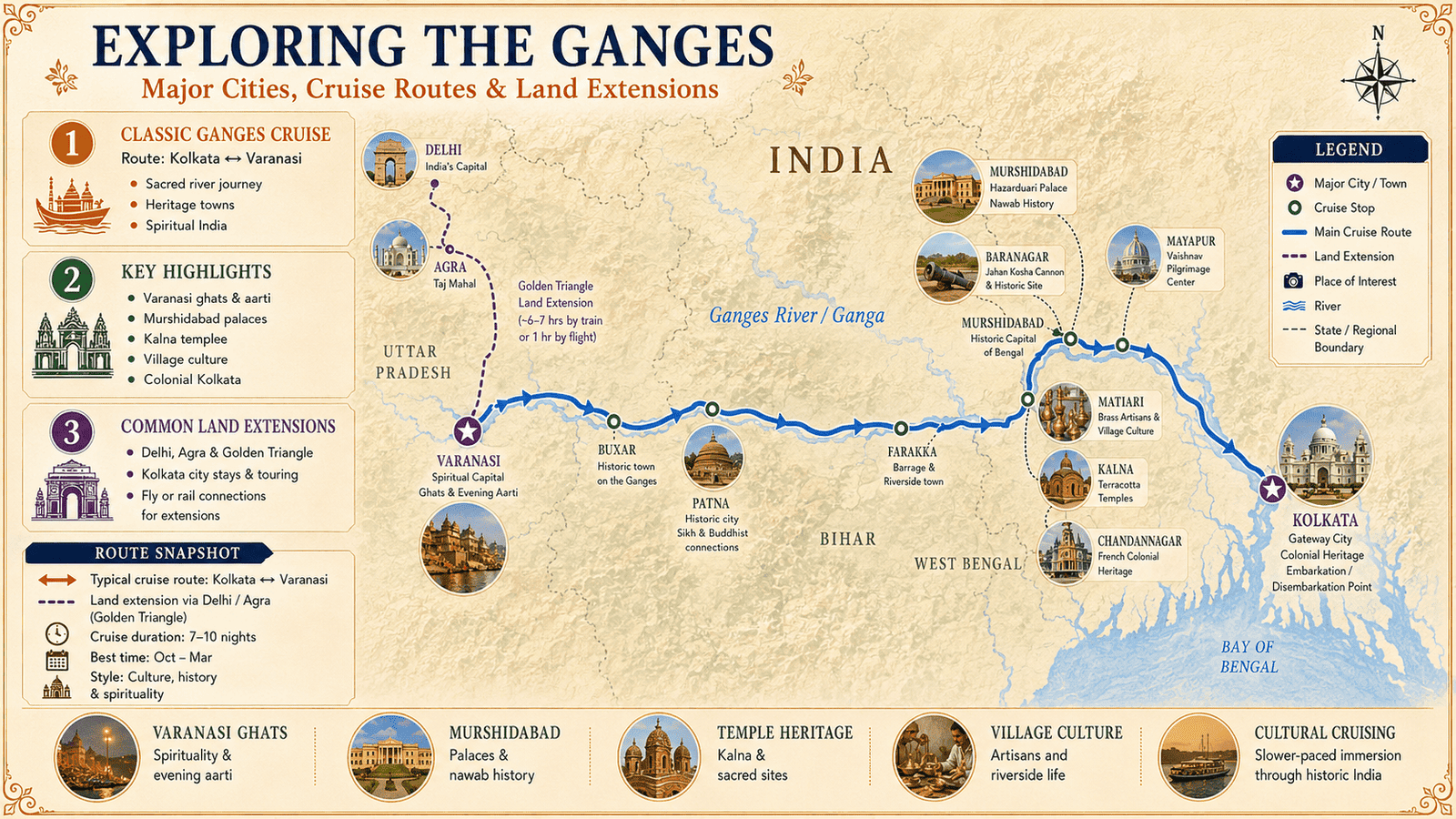
Flowing across northern India, the Ganges is one of the most sacred rivers in the world. Cruising here is not mainly about dramatic scenery. It is about religion, history, local life and cultural immersion.
Most itineraries focus on sections between Kolkata and Varanasi, or shorter routes through West Bengal and Bihar. Depending on the cruise, you may visit riverside villages, temples, historic towns, markets and important cultural sites.
For many travellers, Varanasi is the emotional centre of the journey. The ghats, evening ceremonies, temples, pilgrims and daily life along the river create an atmosphere that is completely different from a European river cruise.
This is not always a gentle introduction to river cruising. India can be colourful, busy, spiritual, confronting, beautiful and deeply memorable all at the same time.
That is why the Ganges may be better suited to travellers who actively want a deeper cultural experience rather than those looking for a simple, polished, resort-style cruise.
The best time to travel is generally during the cooler dry season, from around October to March. This is when temperatures are usually more comfortable for sightseeing.
Cruise operators on the Ganges are more limited than on the Mekong, but you may find companies such as Viking, Uniworld and India-focused operators offering selected itineraries.
The Ganges can be extraordinary, but it is not necessarily the easiest first Asian river cruise. It suits travellers who are curious, open-minded and ready for a more intense cultural journey.
Brahmaputra River Cruises: Wildlife, Tea Country and Remote India
The Brahmaputra is one of the most interesting options for travellers who have already done the better-known routes and want something more adventurous.
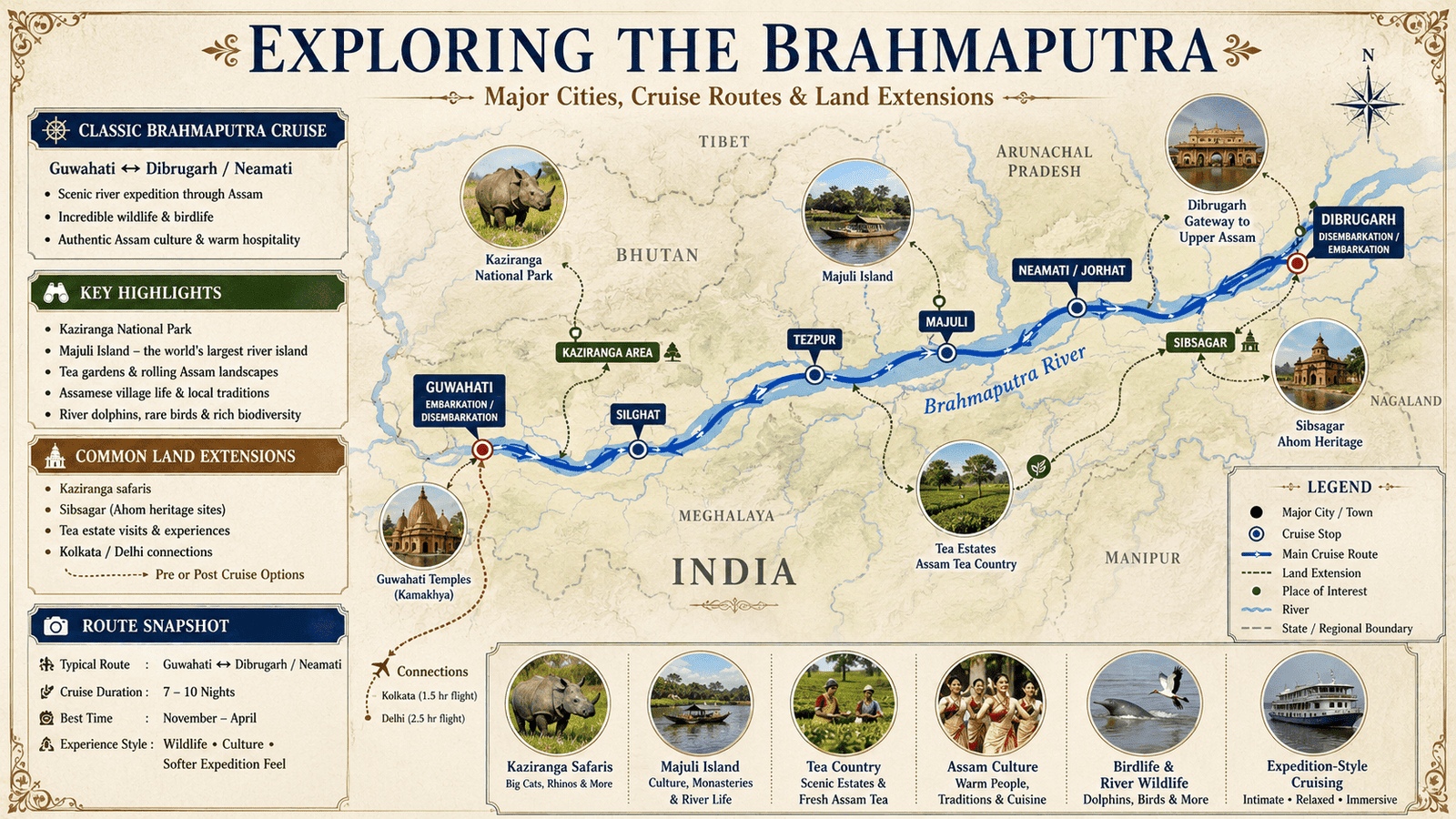
The river flows through Assam in northeast India, and cruises here are often focused on wildlife, tea country, temples, local villages and regional culture.
One of the major highlights is access to Kaziranga National Park, famous for the Indian one-horned rhinoceros. Some itineraries may also include tea plantations, Assamese villages, birdlife, river dolphins, temples and safari-style excursions.
This is not the obvious first Asian river cruise for everyone. It can feel more remote, and weather conditions can have a major impact. The monsoon season and flooding are important considerations, so timing matters.
The best time to travel is generally during the drier months, often from around November to April. This is when conditions are usually more suitable for cruising and wildlife viewing.
The Brahmaputra is particularly well suited to wildlife lovers, repeat river cruisers, adventurous senior travellers and people who want a more unusual side of Asia.
It is less about classic sightseeing and more about atmosphere, nature and regional discovery.
Because operators are more specialised, it is important to compare the exact ship, itinerary, activity level and inclusions before booking. For some travellers, this could be one of the most rewarding Asian river cruise experiences. For others, the Mekong or Yangtze may be a more comfortable starting point.
Red River Cruises: Northern Vietnam Beyond the Usual Route
The Red River in northern Vietnam is a much more niche option than the Mekong.
While the Mekong is the best-known Vietnam and Cambodia river cruise region, the Red River focuses more on northern Vietnam around Hanoi and the surrounding countryside.
Typical itineraries may include Hanoi, the Red River Delta and rural areas, sometimes with land extensions to nearby destinations. The experience is usually less about famous bucket-list landmarks and more about village life, local traditions, temples, crafts, northern landscapes and quieter cultural immersion.
Compared with the Mekong, the Red River is generally less commercial and less familiar to many travellers. That can make it appealing if you have already visited Southeast Asia before or want something more unusual than the classic Mekong route.
It is probably not the first choice for everyone. If this is your first trip to Asia, the Mekong may offer a broader and more accessible introduction. But if you are particularly interested in Vietnam beyond the standard tourist route, the Red River can offer a very different perspective.
Operators are more limited here, with companies such as Pandaw and selected boutique operators offering itineraries in northern Vietnam.
If you are comparing Vietnam and Cambodia cruise options more broadly, you may also find our article on solo seniors and Mekong cruises helpful, especially if you are concerned about travelling alone or choosing a more manageable route.

Which Asian River Cruise Is Best for First-Time Travellers?
For most first-time Asian river cruisers, the Mekong is probably the easiest place to begin.
It offers a good mix of culture, comfort, scenery and organised touring. You get temples, villages, markets, local life and history, but with enough cruise infrastructure to make the journey feel manageable.
The Yangtze may also suit first-time travellers if they are planning a broader China trip and prefer a larger ship experience. It is less intimate than the Mekong, but the Three Gorges route is a major reason to consider it.
The Ganges is better for travellers who actively want a more spiritual and culturally intense journey. The Brahmaputra is best for wildlife lovers and adventurous travellers. The Red River is more niche and may suit repeat visitors to Vietnam or travellers who want something quieter and less mainstream.
So the best Asian river cruise is not simply the one with the most famous name or the best price. It is the one that matches your comfort level, curiosity and reason for travelling.
If you are still at the early planning stage, you may want to compare river cruising with other senior-friendly cruise styles. Our guide to the best cruise lines for seniors can help you think more broadly about comfort, service style and itinerary choice.

How to Compare Asian River Cruise Lines
Once you have chosen the river, then you can compare the cruise lines.
This is where many travellers do things in the wrong order. They start with the cruise company, then try to decide where to go. But in Asia, the river often matters more than the brand.
For example, a cruise line that is excellent on the Mekong may not operate on the Brahmaputra. A company offering a comfortable China river cruise may not provide the same boutique experience you would find in Vietnam or Cambodia.
When comparing cruise lines, look carefully at ship size, passenger numbers, cabin style, dining, drinks, excursions, activity level, transfers, included touring, solo traveller policies and mobility requirements.
Also check whether the itinerary includes hotel stays, domestic flights, visas or land touring, because these can significantly affect the final cost.
Season is another major factor. A cheaper fare during a hotter, wetter or less comfortable period may not be better value if it affects your enjoyment of the trip.
For current itinerary and price research, you can browse river cruise options through CruiseDirect or compare reviews and cruise information through Cruise Critic. After that, it is always sensible to confirm the exact inclusions directly with the cruise line or travel provider before booking.
Travel insurance is also important for Asia, especially if your itinerary includes remote areas, multiple countries, medical considerations or pre-existing conditions. You can compare travel insurance options through VisitorsCoverage before you finalise your trip.
Use the Spreadsheet Before You Book
If you are seriously comparing Asian river cruises, the easiest way to make sense of the options is to see them side by side.
👉 Open our Asian River Cruise Comparison Spreadsheet
The spreadsheet compares the main rivers, routes, seasons, cruise operators, ship sizes, cabin styles, inclusions, solo traveller suitability, family suitability and quick-match guidance.
It is designed to help you narrow the decision before you spend hours jumping between cruise line websites.
Final Thoughts: Choose the River Before the Cruise Line
When you step back and look at Asian river cruising, the first decision is not really the ship or even the cruise line. It is the river.
The Mekong, Yangtze, Ganges, Brahmaputra and Red River all offer very different travel experiences.
The Mekong is often the easiest first step into Asian river cruising, especially for travellers interested in Vietnam and Cambodia. The Yangtze is about scale, scenery and China’s great river journey. The Ganges is spiritual, cultural and intense. The Brahmaputra is wilder, more remote and stronger for wildlife. The Red River is quieter, more niche and focused on northern Vietnam.
Once you understand those differences, choosing the cruise line becomes much easier.
There is no single best Asian river cruise for everyone. The best choice depends on whether you want comfort, culture, scenery, wildlife, spirituality, soft adventure or a deeper connection with local life.
And that is the real value of doing an Asian river cruise comparison before you book. You are not just comparing prices. You are choosing the kind of journey you want to have.