Choosing a cruise along the Rhine initially appears straightforward: select a cruise line, choose a cabin, check the price and make the booking. However, learning how to choose a Rhine river cruise requires looking beyond the brand name and headline fare to understand what kind of holiday you are actually buying.
When we booked our first Rhine cruise with Viking at Christmas, we did what many first-time river cruisers do. We chose one of the largest and most visible companies in the industry—a brand that appeared repeatedly in online searches, advertisements and travel agency recommendations.
There was nothing wrong with our Viking cruise, and we enjoyed the experience. However, had we known then what we know now, we might have chosen a different itinerary, ship or cruise line.
The most important lesson was that Rhine cruises are not simply different versions of the same holiday. Two ships may travel along similar sections of the river and visit several of the same destinations, yet the experience can be remarkably different.
One vessel may carry fewer than 100 guests and feel like a quiet boutique hotel. Another may accommodate nearly 300 passengers and operate more like a small floating resort. One fare may include drinks, excursions, gratuities and transfers, while another may look considerably cheaper until those extras are added.
The real question is therefore not, “Which Rhine cruise is best?”
It is, “Which Rhine cruise is best for the way we want to travel?”
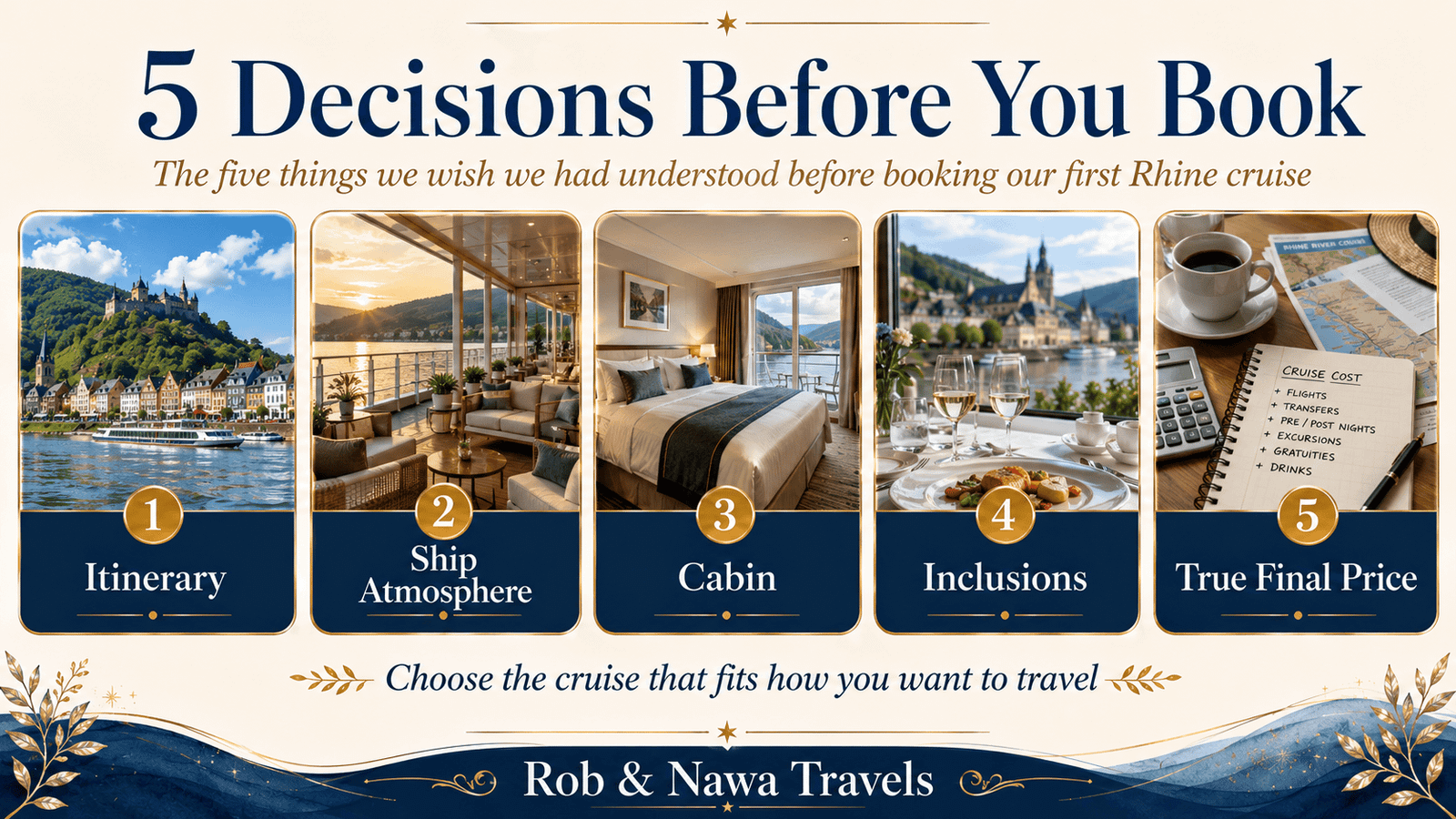
To answer that, we researched 16 cruise lines offering Rhine itineraries and compared five areas: the itinerary, ship atmosphere, cabin, inclusions and true final price.

Start with the Rhine itinerary, not the cruise line
The Amsterdam-to-Basel route is one of the most popular introductions to European river cruising. A typical seven-night journey is long enough to settle into life aboard the ship, experience several destinations and enjoy scenic sailing without committing to a much longer holiday.
Starting or finishing in Amsterdam is also convenient for international flights and gives travellers an excellent opportunity to extend the trip by a few days.
Amsterdam is far more than an embarkation port. One of the most memorable moments from our first Rhine cruise was visiting the Anne Frank House. Standing inside the building where Anne Frank and seven other people hid during the Second World War gave the city an emotional depth that photographs could never fully convey.
However, Amsterdam may not be your main priority.
You may care more about Cologne Cathedral, the vineyards and castles of the Middle Rhine, Strasbourg’s historic centre, the Loreley region or extending your holiday into Switzerland from Basel.
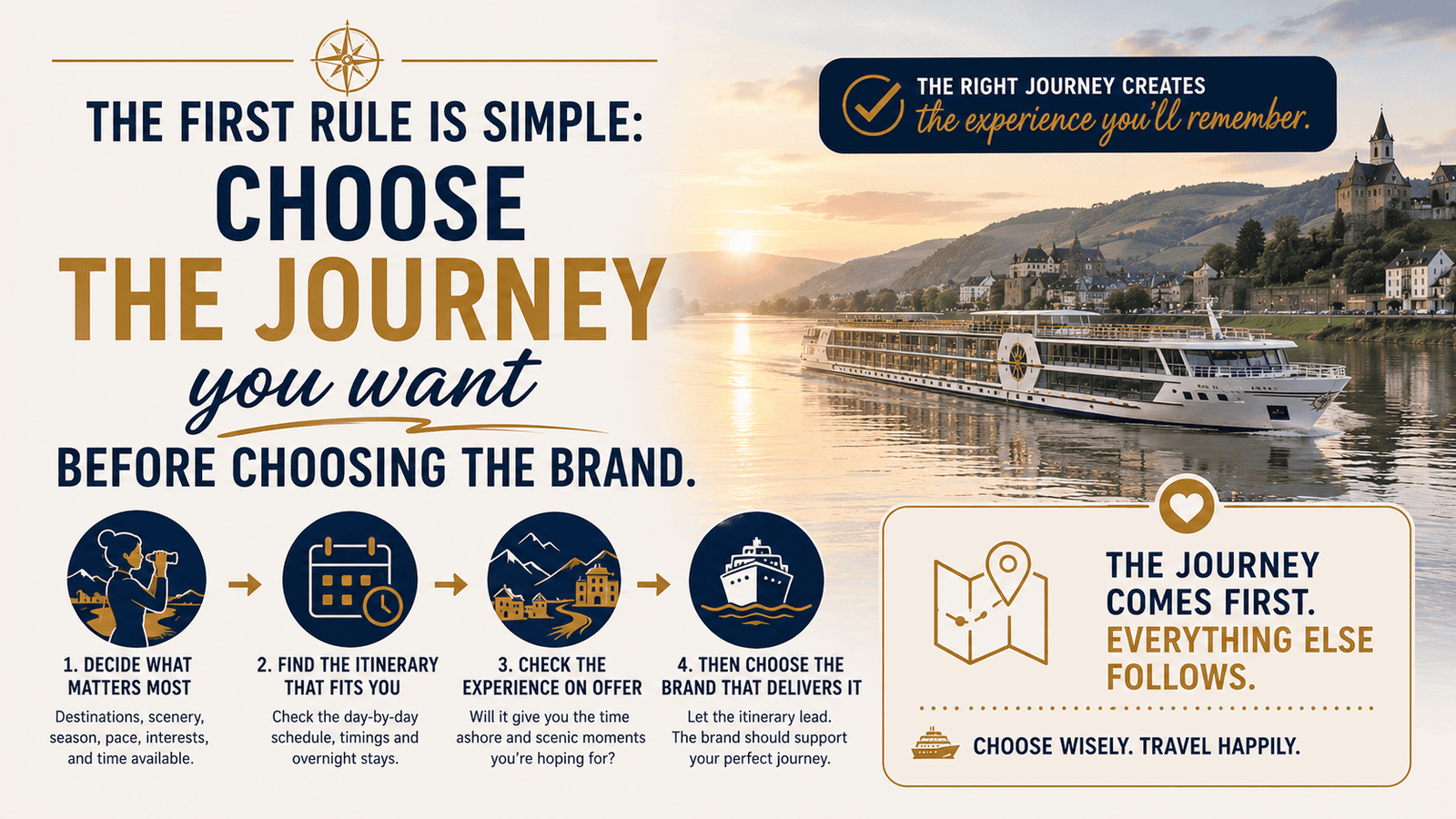
Before comparing cruise lines or prices, write down the three or four places you would most regret missing. Then study each day-by-day itinerary rather than relying on titles such as “Romantic Rhine,” “Rhine Discovery” or “Rhine Explorer.”
Those names may sound impressive, but they do not tell you how much time you will actually have in each destination.
A cruise that arrives at 8:00 a.m. and remains until late evening offers a very different experience from one that docks after lunch and leaves before dinner. This is especially important during Christmas-market cruises. A ship that departs before the market lights come on may prevent you from experiencing the evening atmosphere that makes these events so appealing.
The same applies to scenic sailing. Passing through the Middle Rhine’s castles and vineyards during the afternoon is very different from sailing through the area during breakfast, dinner or after sunset.
The itinerary is not merely a list of destinations. It is the combination of arrival times, departure times, sailing periods and opportunities to explore ashore.
For a broader overview of the major European waterways, read our European River Cruise Comparison Guide before deciding whether the Rhine is the right river for you.
River conditions can change the journey
River cruising depends on conditions that neither the passengers nor the cruise line can fully control.
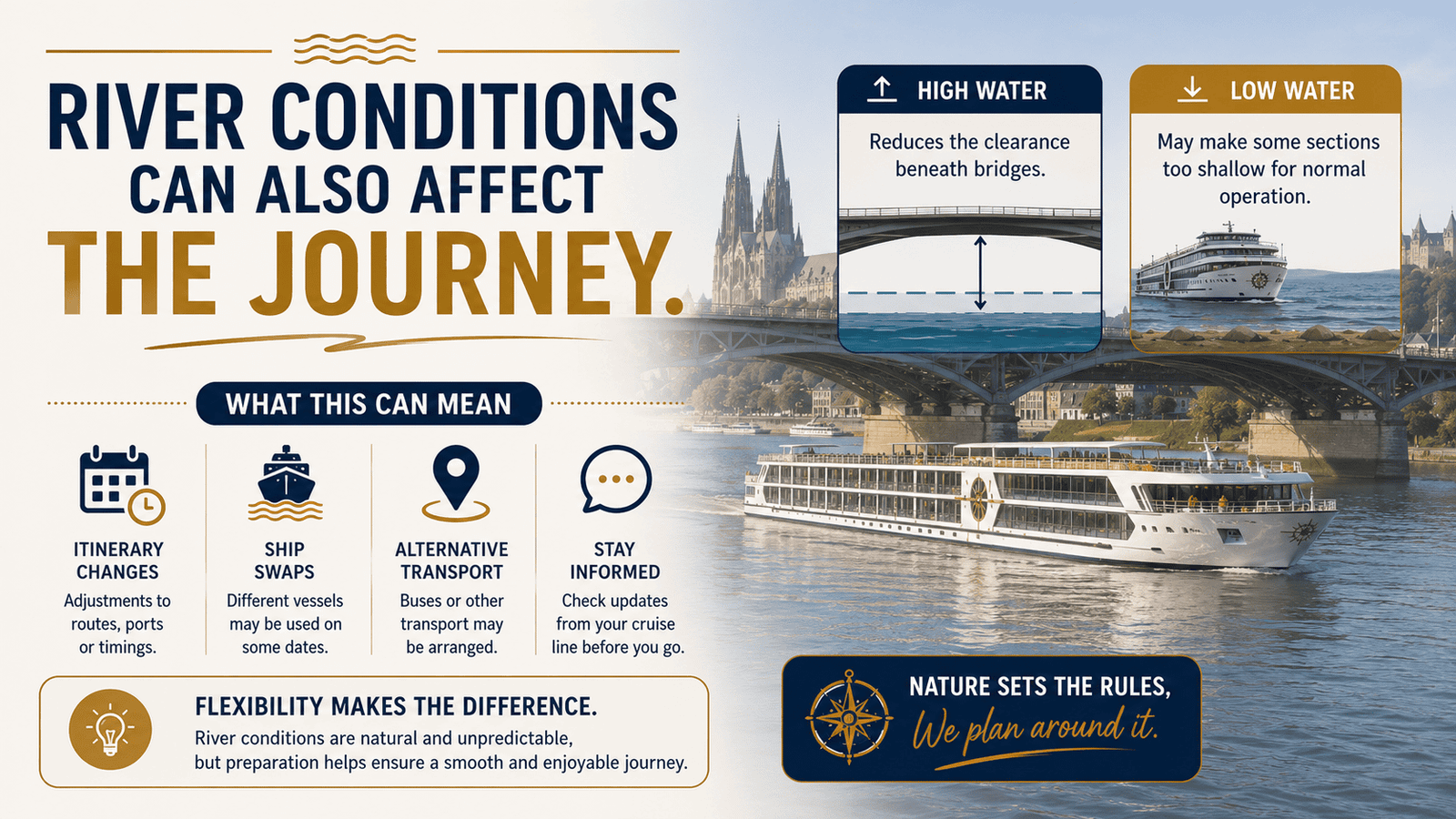
High water can reduce clearance beneath bridges, while very low water may make certain sections too shallow for normal navigation. When this happens, a cruise line may alter its timetable, change docking locations, replace part of the journey with a coach transfer or, in some circumstances, move passengers to another ship.
Larger operators may have more vessels and logistical options available, but that does not guarantee a seamless ship swap.
This does not mean you should avoid booking a river cruise. It simply means that flexibility is important. Read the cruise line’s terms, check what happens when the ship cannot complete the advertised route and make sure your travel insurance is appropriate.
The first rule remains simple: choose the journey you want before choosing the brand.
How to choose a Rhine river cruise ship atmosphere
Once you have identified the right route, consider the kind of onboard environment you prefer.
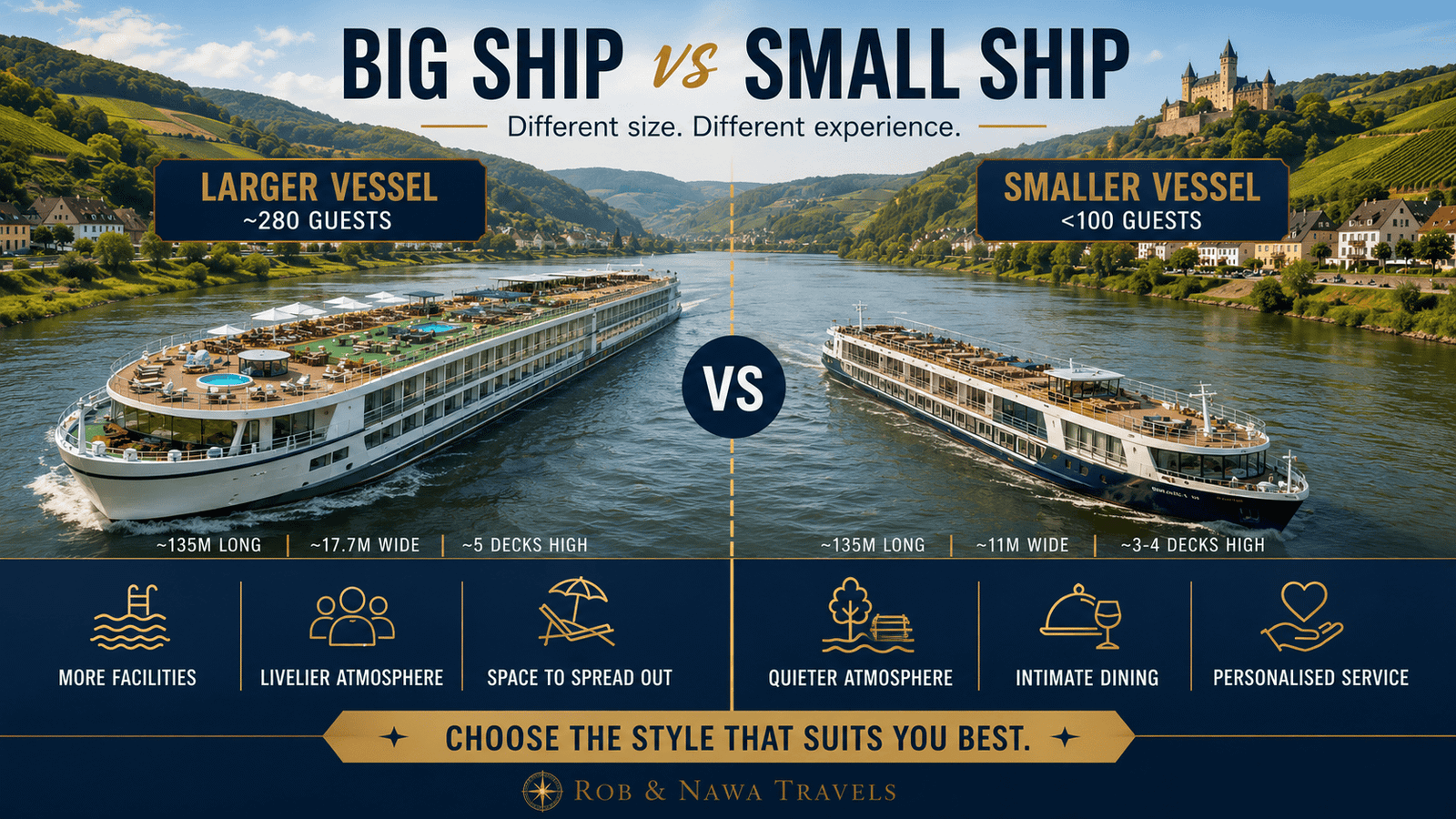
Many Rhine river ships look similar from the outside because they must pass beneath bridges and navigate channels and locks with restricted dimensions. Most are long, relatively narrow and built low to the water.
Inside, however, they may be completely different.
A-ROSA SENA is one of the clearest examples. It is approximately 135 metres long, unusually wide for a river ship and capable of carrying around 280 passengers. Its facilities include family cabins, multiple dining areas, a children’s club, separate adult and children’s pools, and extensive spa facilities.
The result is closer to a floating family resort than a traditional narrow river vessel.
Now compare that with a smaller ship carrying fewer than 100 guests. It may have fewer restaurants, no pool and less entertainment, but it can offer a quieter atmosphere, less crowded public areas, more intimate dining and highly personalised service.
Neither experience is automatically better.
Some travellers want a lively, family-friendly ship with numerous facilities. Others prefer a social premium cruise with organised activities and a welcoming lounge. Some want something closer to a peaceful boutique hotel.
This is also why cruise reviews can be confusing. One passenger may describe a ship as quiet and elegant, while another considers the same atmosphere too formal or overly structured. Both opinions can be valid because the travellers wanted different holidays.
When reading reviews, focus on why the reviewer awarded the score. Comments about entertainment, dining times, dress expectations, passenger age, noise and social atmosphere often reveal more than the rating itself.
For more direct brand comparisons, see:
Viking vs Uniworld River Cruise
Viking vs AmaWaterways vs CroisiEurope
Look beyond the cabin category name
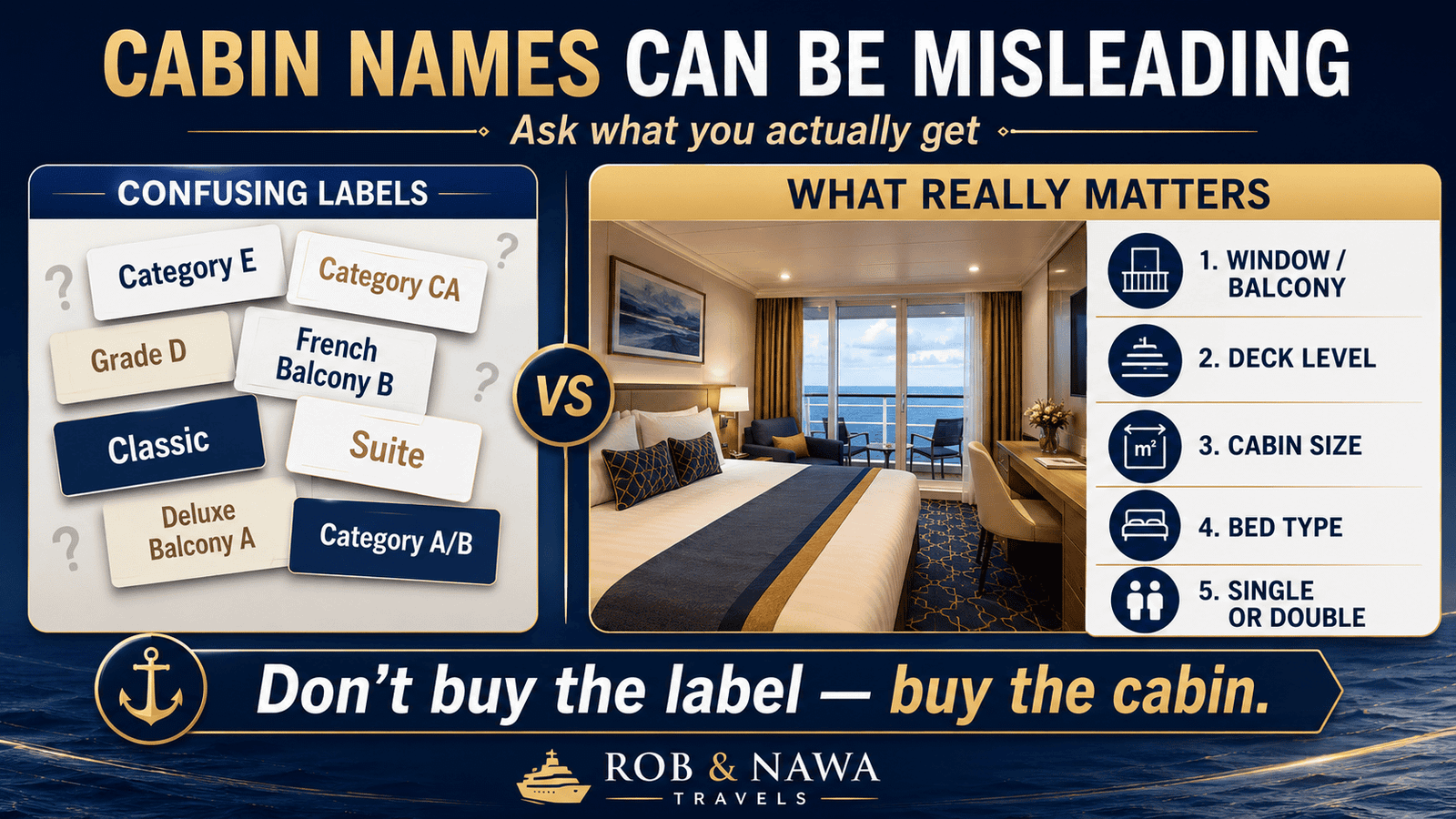
Cruise-line cabin names can be surprisingly unhelpful.
Labels such as Category E, Category CA, Grade D, Classic, Deluxe or Panorama tell you very little unless you already know the ship and its deck plan.
Instead of asking what the category is called, ask what you physically receive.
The least expensive cabins are normally located on the lowest passenger deck. They may have portholes or fixed picture windows positioned close to the waterline. The window usually does not open, but the cabin can still provide natural light and a river view.
These cabins may offer excellent value if you plan to spend most of your day ashore, in the lounge or on the sun deck.
One of our viewers told us they regularly select the least expensive cabin and enjoy the passing scenery from the upper deck, where they can see both sides of the river rather than being limited to the view from one cabin window.
The next level is commonly described as a French balcony. Despite the name, it normally does not have an external platform that you can step onto. It is usually a floor-to-ceiling opening window or sliding glass door with a safety railing.
Some ships have panoramic windows that lower electronically. Others provide genuine exterior balconies with chairs and a small table. These designs are not equivalent, even though they may all be marketed using the word “balcony.”
We often prefer a French balcony because it provides fresh air and an open view without taking substantial space away from the cabin interior.
A genuine exterior balcony may be important to you, but remember that river ships are relatively narrow. Creating separate outdoor space can reduce the usable room inside the cabin. The balcony may also be used less than expected during cold, wet or extremely hot weather.
Before paying for an upgrade, ask four practical questions:
Can we physically step outside? Is the cabin itself larger? Does the bed face the river? How much time will we realistically spend in the cabin?
The best cabin is not necessarily the most expensive. It is the cabin whose features you will genuinely use.
Compare inclusions according to their value to you
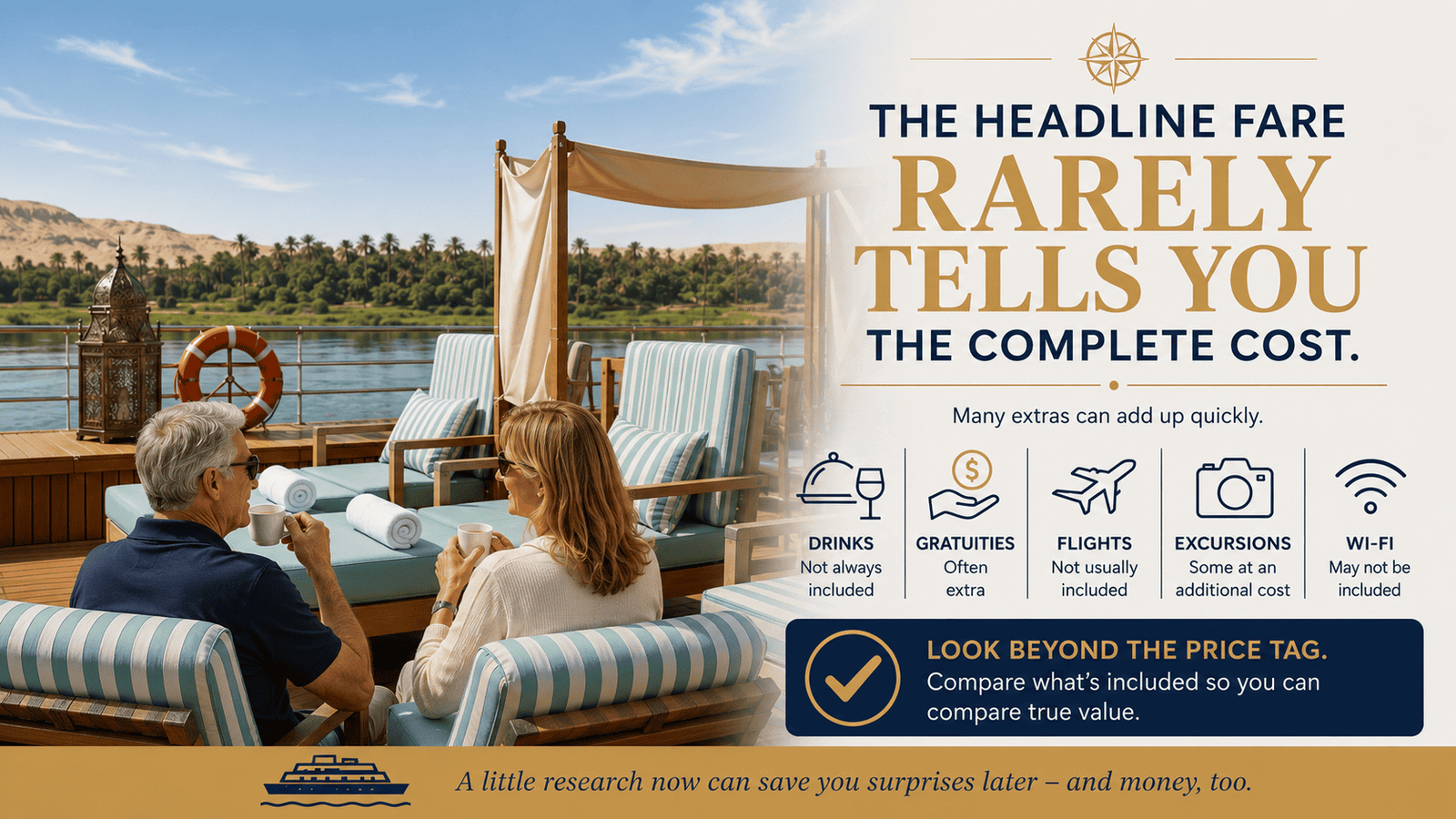
The headline fare rarely tells you the complete cost of a Rhine cruise.
Drinks provide a good example. Some cruise lines include wine, beer and soft drinks only with lunch and dinner. Others add a complimentary happy hour. More inclusive companies may cover drinks throughout the day, although the brands and types available can still vary.
A non-drinker may receive little value from an expensive unlimited beverage package. A couple who enjoy wine with lunch, cocktails before dinner and a nightcap may consider the same inclusion genuinely worthwhile.
Excursions can make an even greater difference.
On the fares and itineraries we researched, companies such as Scenic, Uniworld, Tauck, Avalon and AmaWaterways generally offered broader excursion choices. These could include coach-based sightseeing, gentle guided walks, longer walking tours, cycling excursions and more specialised cultural experiences.
For travellers with mobility concerns, this choice can be especially important. Being able to select a gentle walk instead of a fast-paced three-hour tour can determine whether the day feels enjoyable or exhausting.
Other passengers prefer to explore independently. For them, a cruise with optional excursions may provide better value because they are not paying in advance for organised tours they do not intend to join.
Cruise lines such as CroisiEurope, Amadeus and A-ROSA may allow passengers to select additional tours, arrange their own activities or explore independently, depending on the specific fare and itinerary.
The correct question is not, “Which cruise includes the most?”
It is, “Which included services would we otherwise purchase and genuinely use?”
Check gratuities, transfers and flights
Gratuities can add a noticeable amount to the final price, particularly when charged per passenger, per day. Check whether they are included, automatically added or left to your discretion.
Airport transfers also require careful attention. Some fares include transfers only when flights are booked through the cruise line. Others provide transfers on specific embarkation and disembarkation days, while cruise-only fares may not include them at all.
Flights make comparisons even more complicated.
Saga, for example, offers packages designed primarily for the UK market and may include return travel from Britain. Gate 1 Travel and Grand Circle may package their products differently for American travellers.
These products cannot be compared directly with a simple cruise-only fare without separating the included flights, transfers, tours and other services.
After narrowing your options, you can also compare current river-cruise offers through CruiseDirect. Prices and availability change frequently, so treat advertised deals as a starting point and confirm every inclusion before booking.

Use our spreadsheet as a filter, not the answer
Only after deciding on the itinerary, ship atmosphere, cabin and inclusions should you begin comparing prices.
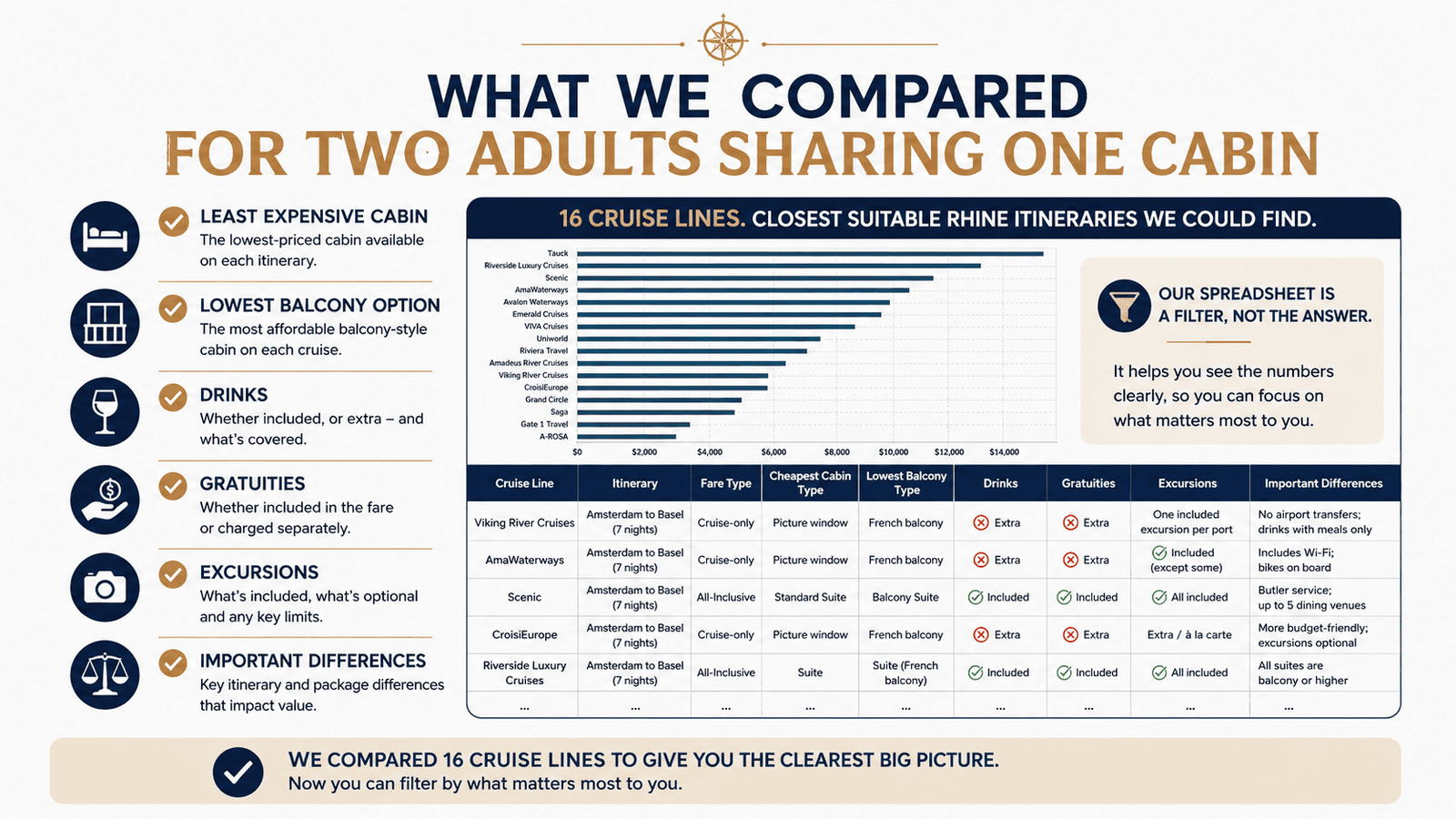
Our Rhine River Cruise Comparison Spreadsheet contains research covering 16 cruise lines and the closest suitable Rhine itineraries we could find.
The main prices are shown for two adults sharing one cabin. We recorded the least expensive cabin, the lowest balcony-style option, drinks, gratuities, excursions and significant differences between the itineraries and packages.
However, do not begin by sorting the spreadsheet from cheapest to most expensive.
First, remove the cruises that do not visit your priority destinations. Next, remove ships whose size or atmosphere does not suit you. Then choose the cabin type you genuinely need and eliminate packages containing expensive inclusions you would not use.
Only then should you compare the adjusted prices of the remaining choices.
By following this process, you may reduce a list of 16 cruise lines to four or five realistic possibilities.
In our research, the price difference between the least expensive and most expensive options was considerable. However, these were not identical itineraries or cruise products. One might focus on highly inclusive, small-group touring, while another provides a larger, resort-style experience with some services purchased separately.
The point is not that one is overpriced and the other is a bargain.
They are selling different holidays.
For more comparisons across brands, ships and destinations, visit our main European River Cruise Comparison page.
The five questions to ask before booking
Before paying a deposit, ask yourself five questions.
Where does the cruise go, and how much useful time will we have in each destination?
What atmosphere does the ship provide, and how many passengers does it carry?
What cabin are we physically receiving, rather than simply what is the category called?
Which drinks, excursions, gratuities, transfers and flights are included, and will we genuinely use them?
What is the total price after adding the extras we would actually purchase?
The best Rhine cruise is not automatically the cheapest, the most luxurious or the highest-rated. It is the cruise whose itinerary, ship, cabin, inclusions and final cost best match the way you want to travel.